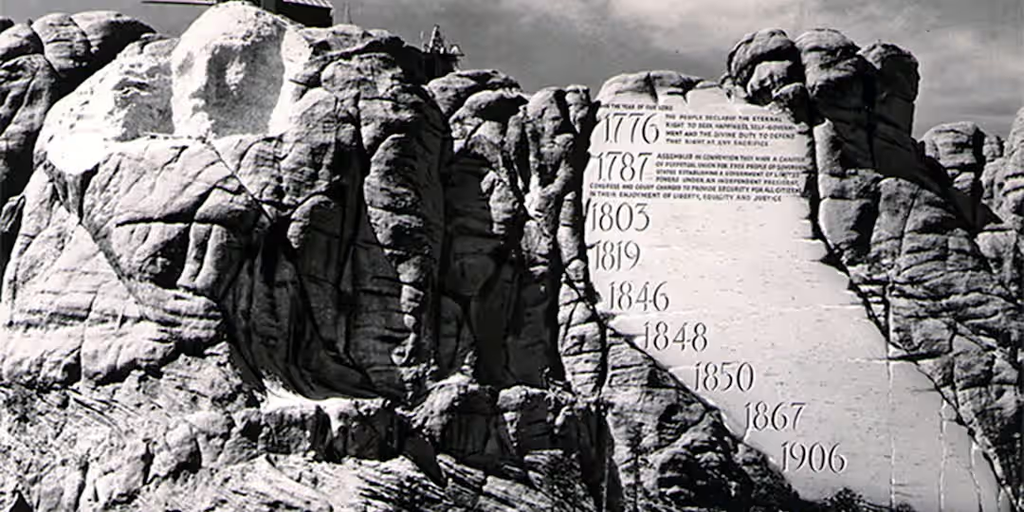
Mount Rushmore is one of America’s most recognizable landmarks. Carved into the granite face of the Black Hills in South Dakota, the enormous monument depicts four presidents: George Washington, Thomas Jefferson, Theodore Roosevelt, and Abraham Lincoln. Millions of visitors travel to see these monumental sculptures each year, drawn by their scale, historical significance, and remarkable craftsmanship.
Yet Mount Rushmore contains a lesser-known feature that many visitors never see: a chamber concealed behind Abraham Lincoln’s head. Often described as a secret room, this space was originally envisioned as part of a much grander plan by sculptor Gutzon Borglum. He wanted to create more than a collection of presidential portraits. His ambition was to build a monument that would preserve important documents and tell the story of the United States for generations to come.
The chamber, known as the Hall of Records, reveals a fascinating chapter in the history of Mount Rushmore. Although the original vision was never completed as intended, the space remains an important reminder of the monument’s unfinished ambitions and the desire to preserve America’s national story.
What Is the Secret Chamber Behind Abraham Lincoln’s Head?
The chamber behind Abraham Lincoln’s head is commonly known as the Hall of Records. Unlike the four enormous presidential sculptures visible from the monument’s main viewing areas, this space is tucked into the granite mountain and is not part of the usual visitor experience.
Its existence has contributed to the mystery surrounding Mount Rushmore. The word “secret” may suggest a hidden room filled with mysterious objects, but the chamber’s actual history is connected to a documented architectural plan rather than an unknown conspiracy.
Gutzon Borglum, the sculptor responsible for the monument, envisioned the Hall of Records as a place where future generations could discover important information about the United States. He wanted visitors and historians of the future to understand why the monument had been created and what its subjects represented.
The room was therefore intended to serve an educational and commemorative purpose. It was conceived as a repository for historical records and explanations of America’s founding principles, achievements, and development.
The chamber’s location behind Lincoln’s head helped protect it from the immediate visual prominence of the main monument. However, the original plan involved far more than simply carving a room into the mountain. Borglum imagined an elaborate architectural space that would help preserve the meaning of Mount Rushmore long after its creators were gone.
Gutzon Borglum’s Grand Vision for the Hall of Records
Gutzon Borglum began working on Mount Rushmore in 1927. His goal was to create a monumental sculpture that celebrated selected figures in American history while attracting national attention to the Black Hills.
The four presidents were chosen to represent different aspects of the country’s development. George Washington symbolized the birth of the nation, Thomas Jefferson represented its expansion and democratic ideals, Theodore Roosevelt reflected economic growth and national development, and Abraham Lincoln embodied the preservation of the Union during the Civil War.
But Borglum did not want the monument to communicate its message through giant faces alone.
He believed that future generations should be able to learn about the people represented on the mountain and the historical events that shaped the nation. The Hall of Records was intended to provide that deeper context.
In his original vision, the chamber would have featured a monumental entrance and a carefully designed interior. It was meant to house important historical documents, records, and explanatory material that could help people understand the significance of the United States and its founding principles.
Borglum imagined the space as a lasting historical archive. Even if the country changed over time, the records inside would provide future visitors with a way to interpret the monument and the era in which it was created.
The concept reflected a broader ambition: Mount Rushmore was supposed to be both a sculpture and a message to the future.
Why Was the Chamber Never Completed as Originally Planned?
Although Borglum devoted considerable attention to the Hall of Records, the project faced practical and financial limitations.
Mount Rushmore was an enormous undertaking. Workers had to remove vast quantities of granite, operate specialized equipment, and carefully shape the rock into recognizable presidential features. The work required years of labor and substantial financial support.
As construction continued, the monument’s primary sculptures took precedence. The Great Depression created additional economic pressures, while funding limitations made it increasingly difficult to complete every element of Borglum’s ambitious design.
The Hall of Records was therefore never finished in the elaborate form he had originally imagined.
Borglum continued to work on the monument until his death in March 1941. By that time, the project had undergone changes, and the original vision for a fully developed historical chamber remained unrealized.
The presidential sculptures themselves were also not completed in every detail originally contemplated. Work on Mount Rushmore ended in October 1941, when the monument was considered complete in its existing form.
The chamber’s unfinished condition reflects the practical reality behind many major public monuments. Artistic ambition can be extensive, but the final result is often shaped by available money, engineering challenges, changing priorities, and the time required to complete the work.
In Mount Rushmore’s case, the Hall of Records survived as a physical reminder of a larger idea that never came fully to life.
What Is Inside the Hall of Records Today?
The chamber’s modern significance differs from Borglum’s original concept.
In 1998, a repository containing historical information about Mount Rushmore and the United States was placed inside the chamber. The installation included a titanium vault containing porcelain panels engraved with historical information and texts associated with the monument.
The records were intended to help future generations understand the history of Mount Rushmore, the presidents depicted on its face, and the ideas associated with the nation’s founding.
This installation did not transform the chamber into a public museum. The Hall of Records remains inaccessible to ordinary visitors, and it is not an attraction that people can simply enter during a standard trip to Mount Rushmore.
Instead, the repository serves a symbolic purpose. It connects Borglum’s original ambition to preserve historical knowledge with a later effort to leave a record for people who may encounter the monument far in the future.
The chamber’s contents are not evidence of a hidden government operation or a mysterious collection of lost treasures. Its documented purpose is preservation and historical interpretation.
That distinction matters because stories about secret rooms can easily become exaggerated. In this case, the genuine history is compelling without needing to add unsupported claims.
Why Was the Hall of Records Placed Behind Lincoln?
The chamber’s location is one reason it attracts so much attention.
Abraham Lincoln occupies the right side of Mount Rushmore’s presidential arrangement when viewed from the front. Behind his carved head, the mountain contains the space associated with Borglum’s archival vision.
The location places the chamber within the same granite landscape as the monument’s most recognizable features. It also illustrates how Mount Rushmore was conceived as a complex construction project rather than merely a flat surface on which faces were carved.
Creating a chamber inside solid rock presented different engineering challenges from shaping the exposed granite into presidential portraits. The work required careful consideration of the mountain’s structure, access, and the practical demands of excavating an interior space.
The placement also contributes to the monument’s symbolism. Lincoln is widely associated with preserving the Union and confronting the moral and political crisis of slavery during the Civil War. A chamber intended to preserve historical records sits behind his likeness, linking the physical monument with the broader idea of historical memory.
That connection should not be mistaken for proof that the chamber was designed exclusively around Lincoln’s personal legacy. Borglum’s stated purpose was to create a place where the history and significance of the United States could be recorded for the future.
Nevertheless, the location adds another layer to the story of a monument already filled with national symbolism.
Mount Rushmore Is More Than Four Presidential Faces
The Hall of Records offers a different way to understand Mount Rushmore.
The monument is often presented as a celebration of American history, with its four presidents representing different stages of national development. But its construction also reveals the choices involved in deciding which stories are remembered and how they are presented.
The project required immense labor, technical skill, government support, and years of work. It also involved decisions about which individuals would receive monumental recognition and which historical experiences would remain less visible.
The Black Hills themselves hold deep significance for Indigenous peoples, particularly the Lakota Sioux. The land is sacred to the Lakota and other Indigenous nations, and the history of the region includes broken agreements, displacement, and continuing disputes over sovereignty and land rights.
This context is essential to a complete understanding of Mount Rushmore. While the monument represents a powerful expression of American national identity, its location also reflects a complicated history that predates its construction.
The Hall of Records cannot resolve these historical tensions, but it invites a broader question: what should future generations know about a national monument?
A historical archive can preserve information, but the meaning of that information depends on how it is presented, interpreted, and discussed. Understanding Mount Rushmore therefore requires looking beyond the sculptures to the people, events, and competing historical perspectives connected to the site.
Can Visitors Enter the Secret Chamber?
For most travelers, the answer is no.
The Hall of Records is not open to ordinary public access. Visitors can explore designated areas of Mount Rushmore National Memorial, view the presidential sculptures, learn about the monument’s construction, and visit public exhibits. However, the chamber behind Lincoln’s head is not part of the regular visitor route.
Its restricted access has helped sustain public curiosity. People naturally wonder what might be hidden inside a room carved into a famous mountain, especially when its original purpose involved preserving historical records.
However, there is no need to imagine that the chamber conceals an undiscovered treasure or a secret political message. Its known history is rooted in Borglum’s plans and the later installation of historical records.
Visitors interested in the chamber can learn about its purpose through information about Mount Rushmore’s design and construction. The broader story is often more revealing than the possibility of entering the room itself.
The Hall of Records demonstrates that a monument can contain layers of history that are not immediately visible from its most famous viewpoint.
The Lasting Mystery of Mount Rushmore’s Unfinished Chamber
More than eight decades after construction ended, Mount Rushmore continues to attract visitors fascinated by its scale, symbolism, and engineering. The Hall of Records adds another dimension to that appeal.
What makes the chamber remarkable is not that it conceals a sensational secret, but that it represents an ambition that extended beyond the monument’s visible surface. Borglum wanted future generations to understand the ideas and historical figures behind the sculpture, and he imagined the chamber as a lasting repository for that knowledge.
Although financial and practical limitations prevented the original plan from being fully realized, the space eventually became associated with a more modest effort to preserve historical information for the future.
Its story also reminds us that monuments are never simply finished objects. They reflect the priorities, limitations, and beliefs of the people who create them, as well as the changing perspectives of those who encounter them later.
Mount Rushmore’s four presidential faces remain its defining feature, but the Hall of Records reveals a lesser-known side of the project: the desire to communicate with people who might live long after its creators were gone.
Ultimately, the chamber behind Abraham Lincoln’s head is not merely a hidden room inside a mountain. It is a reminder that history involves both what we choose to display and what we attempt to preserve for future generations. And that may be the most enduring secret of Mount Rushmore: the monument’s story is much larger than the faces carved into its granite.