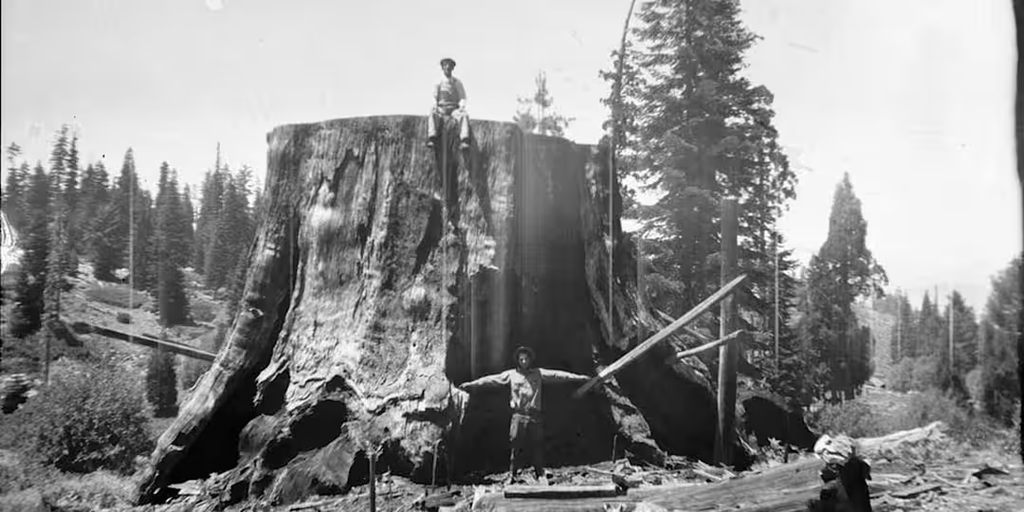
In the mid-19th century, California’s giant sequoias attracted attention for their extraordinary size, age, and commercial potential. These enormous trees, some of which had stood for thousands of years, seemed to offer an almost unbelievable supply of timber. To profit-driven logging companies, a single giant sequoia appeared capable of producing as much as 500,000 board feet of lumber—a staggering quantity that promised enormous financial returns.
Yet the reality was more complicated. Although giant sequoias were among the largest trees on Earth, their size did not make them easy to harvest or turn into valuable building materials. Their massive trunks could shatter when they hit the ground, and their wood often proved difficult to work with using the tools and techniques available at the time. Despite these challenges, logging operations cut down thousands of the ancient trees during the late 19th and early 20th centuries.
The destruction eventually helped inspire a growing conservation movement. As Americans began to recognize that these remarkable trees could disappear, activists, scientists, and public officials pushed to protect the remaining groves. The history of California’s giant sequoias reveals a striking conflict between commercial ambition and environmental preservation—and explains why some of the world’s most impressive trees came dangerously close to being lost.
Why California’s Giant Sequoias Attracted Loggers
Giant sequoias, scientifically known as Sequoiadendron giganteum, grow naturally along the western slopes of California’s Sierra Nevada mountain range. They thrive in specific mountain environments, generally at elevations where seasonal precipitation, snowpack, and soil conditions support their development.
These trees are famous for their enormous trunks and remarkable longevity. Some living specimens are more than 3,000 years old, having survived countless droughts, wildfires, and changes in the surrounding landscape.
When American settlers and entrepreneurs explored California during the 19th century, the scale of the sequoias captured widespread attention. Their trunks could reach extraordinary diameters, and the trees towered above much of the surrounding forest.
For lumber companies, such dimensions suggested a valuable commercial opportunity. During a period of rapid population growth and expanding settlement, timber was essential for homes, barns, bridges, railroads, mines, and other infrastructure.
California’s expanding economy created demand for building materials, while logging companies looked for ways to convert forest resources into profitable products. A tree containing hundreds of thousands of board feet of potential lumber seemed like a natural target.
However, the apparent abundance concealed an important problem: a giant sequoia was not necessarily as commercially useful as its size suggested.
The Promise of 500,000 Board Feet of Lumber
The claim that one giant sequoia could provide approximately 500,000 board feet of lumber illustrates the extraordinary expectations surrounding these trees. A board foot is a unit of lumber volume equal to a piece measuring one foot long, one foot wide, and one inch thick.
Half a million board feet would represent an enormous quantity of timber. In principle, that much lumber could supply materials for many buildings and other construction projects.
For investors and logging operators, the possibility of extracting such a volume from one tree appeared to offer exceptional returns. Rather than harvesting numerous smaller trees, a company might imagine obtaining a substantial amount of wood from a single giant.
But estimates of potential lumber volume should not be confused with the amount of usable timber a logger could actually recover. The final yield depended on the tree’s dimensions, its condition, the length and quality of its trunk, the cutting methods used, and the amount of wood damaged during felling and processing.
The 500,000-board-foot figure should therefore be understood as an illustrative claim associated with the trees’ commercial reputation, not a guaranteed yield from every giant sequoia.
The wood itself also presented challenges. Giant sequoia timber can be relatively brittle compared with some other commercial woods. When a massive tree fell, the impact could split or shatter sections of the trunk, reducing the amount of lumber suitable for sale.
In other words, the enormous size that made the trees attractive also made them difficult and expensive to harvest efficiently.
Why Cutting Down Giant Sequoias Was So Difficult
Felling a giant sequoia was a major undertaking during the 19th century. These trees could weigh hundreds of tons, and their immense trunks required considerable time and labor to cut through.
Loggers did not have modern chainsaws, heavy machinery, or the sophisticated equipment available to contemporary forestry operations. They relied on large crosscut saws, axes, wedges, and other tools to bring down trees of extraordinary dimensions.
The process could take days, depending on the size of the tree and the conditions at the site. Workers had to prepare the cutting area, position equipment, and determine how the tree would fall.
Even after a tree was brought down, the work was far from finished. Its trunk had to be divided into manageable sections, transported to a mill, and processed into lumber.
Moving massive logs through steep mountain terrain presented another obstacle. Roads, hauling systems, and transportation networks were limited in many of the remote groves. Building access routes required additional labor and could damage surrounding vegetation and soil.
The financial calculations were therefore not as simple as comparing the volume of a tree with the market price of lumber. Companies had to account for the cost of cutting, transportation, processing, and waste.
These difficulties made giant sequoias less convenient for ordinary construction than their enormous size might suggest. Nevertheless, commercial logging continued in many areas, driven by demand for timber and the belief that the trees represented a resource worth exploiting.
Thousands of Ancient Trees Were Cut Down
Commercial logging of giant sequoias expanded during the late 19th century, particularly in groves where companies could establish access routes and transport timber to nearby mills.
The trees were harvested for a variety of purposes, including construction materials, fencing, shingles, and other wood products. Some of the resulting lumber entered local markets, while other timber supported the wider growth of California’s developing economy.
However, the destruction was often disproportionate to the usable material recovered. Because the trees were so large, they could break apart when felled, leaving substantial portions of their trunks unsuitable for the intended products.
This created a troubling pattern: enormous living trees were destroyed even when the financial return did not fully justify the effort.
The scale of logging varied considerably between groves. Some areas experienced extensive cutting, while others remained relatively protected because of their remoteness, limited commercial access, or the efforts of people advocating conservation.
It is important to distinguish giant sequoias from California’s coast redwoods, another species of enormous tree that grows closer to the Pacific coast. Both species faced logging pressure, but they occupy different environments and have distinct histories.
Giant sequoias are naturally concentrated in groves across the Sierra Nevada. Their relatively restricted distribution meant that extensive cutting could have lasting consequences for particular groves, even if the species as a whole was not immediately eliminated.
For trees that had taken centuries or millennia to reach their full size, the damage was effectively irreversible on a human timescale.
The Economic Disappointment Behind the Logging Boom
The logging industry’s enthusiasm for giant sequoias was based partly on the assumption that more wood meant more profit. Yet the actual economics could be disappointing.
A tree’s commercial value depends on the amount of usable lumber it produces, not simply on its total volume. If a large portion of the trunk breaks apart during felling or cannot be processed into suitable boards, the expected revenue declines.
The expense of moving the timber also mattered. Giant sequoias often grew in mountainous areas far from major markets. Roads and hauling systems had to be developed before companies could transport large quantities of wood efficiently.
These obstacles reduced the appeal of harvesting the trees in some locations. Smaller, more accessible trees could sometimes offer a more predictable return with less effort.
The mismatch between expectations and reality illustrates a recurring problem in resource extraction. A natural resource may appear extraordinarily valuable when measured by size or abundance, but harvesting it can involve costs and waste that make the operation less profitable than anticipated.
Unfortunately, the limited commercial efficiency of giant sequoia logging did not prevent substantial environmental damage. Even when companies failed to obtain the hoped-for financial return, the felled trees were still lost.
How Conservationists Began Protecting the Giant Sequoias
As logging threatened more groves, conservationists increasingly argued that giant sequoias were too remarkable to be treated simply as timber.
Naturalists, writers, and early environmental advocates emphasized the trees’ age, beauty, and scientific significance. Their arguments helped shift public discussion away from the commercial value of individual trunks toward the importance of preserving entire forest ecosystems.
One major milestone came in 1890, when the United States established Sequoia National Park. The park protected important giant sequoia groves, including areas containing some of the most famous trees in the Sierra Nevada.
The creation of the park reflected a growing willingness to preserve extraordinary natural landscapes for public enjoyment and future generations. It also helped establish the principle that some forests should be protected rather than managed primarily for timber production.
Protection did not happen everywhere at once. Private land ownership, commercial interests, and the challenges of managing remote forests continued to complicate conservation efforts.
Over time, additional protected areas were established, and public awareness of the giant sequoias increased. Conservation became an important part of California’s identity, particularly as visitors traveled to see the monumental trees for themselves.
The surviving groves became living reminders of what had been lost—and of what could still be preserved through deliberate action.
Why Giant Sequoias Matter Beyond Their Size
Giant sequoias are valuable not only because of their impressive dimensions but also because of the ecological roles they play.
Their forests provide habitat for a variety of plants, animals, fungi, and other organisms. Fallen trees, decaying wood, forest soils, and the canopy all contribute to the complexity of the ecosystem.
Fire is also an important part of giant sequoia ecology. Mature trees have thick, fibrous bark that can help them survive many low- to moderate-intensity fires. Fire can clear competing vegetation, expose mineral soil, and create conditions that allow seeds to establish and grow.
However, these forests are not immune to severe environmental threats. Changes in climate, prolonged drought, unusually intense fires, and other pressures can endanger even mature trees that survived for centuries.
Protecting giant sequoias therefore requires more than preventing logging. It also involves managing forest conditions, understanding fire behavior, monitoring tree health, and responding to changing environmental risks.
The history of commercial exploitation offers a useful lesson: once an ancient tree is cut down, its ecological and cultural value cannot simply be replaced by planting a young one. A new sequoia may eventually become enormous, but reaching that stage requires centuries of growth under suitable conditions.
The Lasting Legacy of the 19th-Century Logging Rush
The rush to harvest California’s giant sequoias illustrates the consequences of viewing nature primarily through its commercial potential.
To 19th-century logging companies, the trees represented a possible bonanza of lumber. Their extraordinary size encouraged expectations of immense profits, even though the practical difficulties of felling and processing them often reduced their usefulness as timber.
The resulting destruction helped reveal the limits of that economic perspective. A forest could contain trees of extraordinary value without every tree being suitable for commercial exploitation.
Today, giant sequoias remain among the most remarkable living organisms on Earth. Protected groves allow visitors to stand beneath enormous trunks and appreciate the passage of time on a scale that is difficult to imagine.
Their survival is also a reminder that conservation often begins only after the damage becomes visible. By the time public opinion shifts, generations of trees may already have disappeared.
The 19th-century logging rush did not destroy every giant sequoia, but it demonstrated how quickly commercial ambition could threaten irreplaceable natural treasures.
Ultimately, the story of these ancient trees is about more than timber, board feet, or profits. It is about deciding what a forest is worth—and recognizing that some of the greatest values in nature cannot be measured by the amount of lumber a single tree can provide.