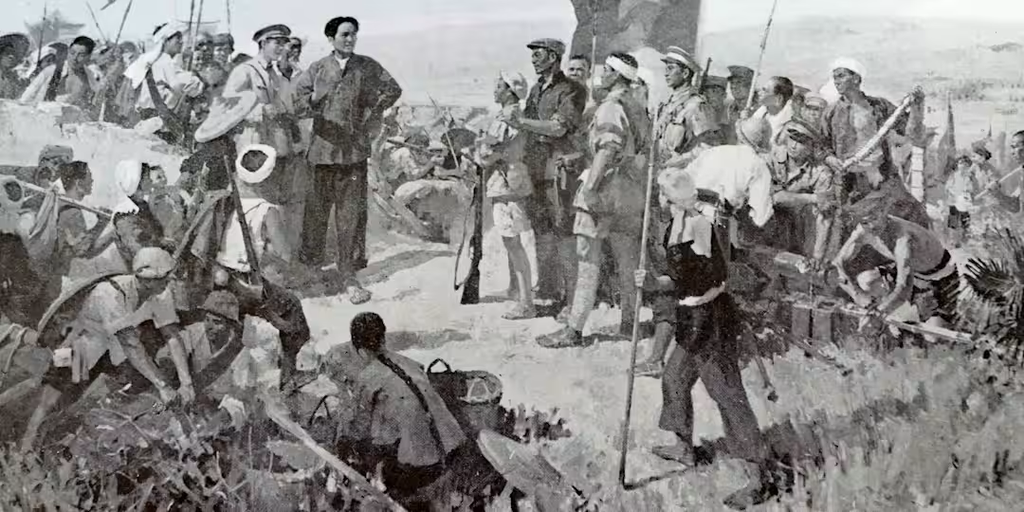
Some moments in history change the course of a nation forever. On October 16, 1934, Chinese Communist forces began one of the most extraordinary military retreats of the 20th century: the Long March. Facing intense pressure from Nationalist forces, the Communists abandoned their stronghold in southeastern China and embarked on a grueling journey across vast and difficult terrain. The march lasted more than a year, covered thousands of miles and tested the endurance of the soldiers who took part.
The Long March became far more than a military withdrawal. It helped reshape the leadership of the Chinese Communist Party, strengthened the political position of Mao Zedong and became a defining story in the movement that eventually brought the Communists to power in China in 1949.
Remembered for its extraordinary hardships, strategic decisions and political consequences, the Long March occupies a central place in modern Chinese history. Its legacy remains influential today, both as a historical event and as a powerful symbol of sacrifice, perseverance and revolutionary determination.
What Was the Long March?
The Long March refers to a series of strategic retreats undertaken by Chinese Communist forces between 1934 and 1936. The best-known phase began in October 1934, when the First Front Army of the Chinese Red Army broke out of the Communist-controlled Jiangxi Soviet in southeastern China.
At the time, the Chinese Communist Party was fighting the Nationalist government led by Chiang Kai-shek. The two political movements had previously cooperated during the First United Front, but their alliance collapsed in 1927. The breakdown led to years of violent conflict between Communist and Nationalist forces.
The Nationalist government subsequently launched a series of military campaigns aimed at eliminating Communist strongholds. By 1934, Nationalist forces had tightened their encirclement around the Jiangxi Soviet, making it increasingly difficult for the Communists to maintain their territory.
Faced with the threat of defeat, Communist leaders decided to withdraw their main military force and attempt to establish a new base elsewhere.
The retreat was not a single, uninterrupted journey by one unified army. Different Communist forces departed from separate regions and followed different routes. The First Front Army’s march from Jiangxi to northern Shaanxi became the most celebrated part of the larger historical episode.
The journey involved battles, difficult terrain, food shortages and substantial casualties. Although the Communist forces eventually reached a new base, the losses were severe.
Yet the retreat preserved a core of experienced Communist fighters and leaders. In the years that followed, that surviving force became central to the party’s continued development and its eventual victory in the Chinese Civil War.
Why Did the Chinese Communists Begin the Long March?
To understand why the Long March began, it is necessary to examine the political and military struggles that divided China during the early 20th century.
Following the fall of the Qing dynasty in 1911, China experienced years of political instability, regional conflict and competition over national leadership. The Nationalist Party, also known as the Kuomintang or KMT, sought to unify the country under its government. The Chinese Communist Party, founded in 1921, pursued a revolutionary program influenced by Marxism and the Russian Revolution.
The two parties initially cooperated against common opponents. However, their alliance broke down in 1927, when Nationalist forces and their allies violently suppressed Communist organizations and supporters in several cities.
Many Communists went underground or retreated to rural areas, where they built armed forces and established revolutionary bases. Jiangxi became one of their most important strongholds.
Chiang Kai-shek’s government viewed these Communist territories as a direct challenge to its authority. Beginning in 1930, Nationalist forces launched successive encirclement campaigns against Communist bases.
The earlier campaigns failed to destroy the main Communist forces, but the fifth major campaign, launched in 1933, proved much more damaging. Nationalist forces used blockhouses, fortified positions and a strategy of gradually restricting Communist territory.
The Communists suffered from diminishing supplies and shrinking room for maneuver. Their military leadership also faced disagreements over strategy. The tactics employed by some commanders, including reliance on conventional positional defense, proved increasingly ineffective against the Nationalists’ methodical advance.
By the autumn of 1934, the Communist position in Jiangxi had become increasingly precarious. Continuing to defend the territory risked the destruction of the Red Army’s principal force.
The decision to withdraw was therefore an attempt to preserve the movement’s remaining military strength. It was a desperate response to a worsening situation, not a march that began with a guaranteed destination or a certain outcome.
The Beginning of the Journey on October 16, 1934
In October 1934, Communist forces began leaving the Jiangxi Soviet. October 16 is commonly associated with the opening of the Long March, although the departure unfolded over several days and involved multiple units.
The retreat required the Red Army to break through Nationalist defensive lines and carry essential equipment, supplies and administrative resources. Large numbers of people accompanied the departing forces, including soldiers, officials, medical personnel and others connected with the Communist base.
The army moved under difficult conditions. Nationalist forces sought to intercept the retreat, while the Communist columns faced the practical challenges of crossing rivers, navigating unfamiliar routes and securing food.
The initial breakout came at a significant cost. The Red Army’s large columns moved slowly, and the heavy equipment and administrative personnel accompanying them limited their mobility.
The Nationalists inflicted serious losses during the early stages of the retreat, particularly as Communist forces attempted to cross defensive positions around the encircled territory.
Nevertheless, the main force escaped the immediate danger of being trapped in Jiangxi. It now faced a different challenge: surviving a long journey through hostile territory while avoiding further encirclement.
At this stage, the eventual significance of the Long March remained uncertain. The retreating army had not yet secured a safe base, and its leaders could not know whether the force would survive the coming months.
What followed would transform the military and political direction of the Communist movement.
Crossing Mountains, Rivers and Dangerous Terrain
The Long March became legendary partly because of the physical demands placed on the soldiers who participated.
The Communist forces crossed mountainous regions, rivers, forests and other difficult landscapes. They traveled through areas where supplies were scarce and local conditions could change rapidly. Weather, hunger, exhaustion and disease added to the dangers of military pursuit.
The marchers often had to carry their equipment while moving through steep or muddy terrain. Roads were limited in many areas, and the army could not rely on a consistent supply system.
Food shortages were particularly serious. As the troops moved farther from their original base, obtaining provisions became increasingly difficult. Soldiers depended on supplies carried with them, resources acquired along the route and assistance available in the areas they crossed.
The Red Army also faced attacks from Nationalist forces and other armed groups. Battles and skirmishes could interrupt movement, force changes in direction and increase casualties.
The experience varied considerably among different units. Some groups followed routes that presented different military and environmental challenges, while others suffered from particularly difficult crossings and severe shortages.
The scale of the journey should not obscure the human cost. Many participants died from combat, illness, starvation, exposure or exhaustion. Others became separated from their units or were captured.
The Long March was therefore not simply an inspiring journey across China. It was a brutal military retreat in which survival required constant adaptation.
Its later symbolic importance grew partly from the contrast between the weakness of the retreating force in 1934 and the political influence the Communist Party would eventually achieve.
The Xiang River Battle and a Turning Point in Leadership
One of the most damaging episodes of the early march occurred during the crossing of the Xiang River in late 1934. Nationalist forces attempted to prevent the Red Army from moving westward, and the fighting inflicted severe casualties on the Communist troops.
The losses exposed serious weaknesses in the army’s strategy and leadership. The force had been burdened by a slow-moving column, while the Nationalists were able to concentrate against its routes of movement.
The disaster intensified dissatisfaction with the military direction associated with the Communist leadership at the time.
In January 1935, Communist leaders met at Zunyi in Guizhou province. The Zunyi Conference became a major turning point in the history of the Chinese Communist Party.
During the meeting, leaders criticized earlier military decisions and reassessed the strategy that had brought the Red Army to the brink of disaster. Mao Zedong’s influence increased substantially, although his rise to undisputed leadership was a process that continued over time rather than a single event completed at Zunyi.
The conference helped shift the party’s military and political direction. Communist commanders gained greater flexibility in their operations, relying more heavily on maneuver and efforts to avoid unfavorable confrontations.
The importance of Zunyi extended beyond immediate military planning. It contributed to Mao’s emergence as the dominant figure in the party and helped shape the leadership structure that would guide the Communist movement in subsequent years.
For that reason, the Long March is often described as a defining episode in Mao’s political rise.
The Dadu River and the Crossing at Luding Bridge
Among the best-known episodes associated with the Long March is the crossing of the Dadu River near Luding Bridge in Sichuan province.
The Dadu River presented a formidable obstacle. Its fast-moving waters and difficult surrounding terrain made crossing dangerous, while the presence of opposing forces increased the military challenge.
Luding Bridge, a suspension bridge with a wooden deck, became central to the Communist account of the march. In the widely celebrated version of events, Red Army soldiers launched a daring assault across the bridge to secure a crossing before Nationalist forces could block their progress.
The episode became one of the most dramatic stories in official accounts of the Long March. It was portrayed as an example of extraordinary courage and determination under extreme conditions.
Historians have examined aspects of the traditional account, including the precise circumstances of the fighting and the scale of the resistance encountered. As with other events from the Long March, the distinction between historical evidence and later political commemoration is important.
The bridge crossing nevertheless became an enduring symbol of the army’s ability to overcome seemingly impossible obstacles.
In later decades, Luding Bridge occupied an important place in Chinese revolutionary memory. It was presented as evidence that determination, discipline and strategic ingenuity could allow a smaller force to survive against a more powerful opponent.
The story illustrates how the Long March developed two interconnected legacies: the military experience of those who participated and the political narrative constructed around their journey.
The Long March Reaches Northern Shaanxi
After months of movement and repeated military challenges, surviving members of the First Front Army reached northern Shaanxi in October 1935. There, they joined Communist forces that had already established a base in the region.
The arrival marked the conclusion of the best-known phase of the Long March, although other Communist armies continued their own difficult journeys until 1936.
The surviving force was far smaller than the army that had originally left Jiangxi. The losses had been devastating, and the retreat had consumed enormous resources.
Nevertheless, the Communists had preserved a core of experienced fighters and political leaders. Northern Shaanxi offered a new base from which the party could rebuild its organization and continue its struggle against the Nationalists.
The geographical relocation also had important strategic consequences. The Communist movement had escaped the immediate threat of destruction in its southern stronghold and established itself in a region from which it could reorganize.
The journey did not bring the Communist Party to national power immediately. The party remained militarily weaker than the Nationalist government, and the political future of China was still uncertain.
However, the survival of the Red Army allowed the Communists to continue developing their organization and political influence.
The Long March thus represented both a major defeat in terms of lost personnel and territory and a strategic survival that helped preserve the movement.
How the Long March Changed the Chinese Communist Party
The Long March had consequences that extended far beyond military survival.
First, it contributed to the transformation of the party’s leadership. The Zunyi Conference strengthened Mao Zedong’s position and helped establish the political direction that would shape the Communist movement for years.
Second, the march created a powerful shared experience among the survivors. Those who completed the journey became central figures within the party and its military organization. Their participation later carried political significance, helping establish reputations and strengthen the movement’s internal identity.
Third, the retreat became a source of revolutionary legitimacy. Communist leaders presented the march as evidence that the party could withstand extreme hardship and remain committed to its goals despite overwhelming opposition.
The journey was subsequently incorporated into party education, official histories, literature, art and public commemoration. Stories of sacrifice and perseverance became central to the political narrative surrounding the Communist revolution.
At the same time, the Long March must be understood in the context of later developments. The Communist victory in 1949 resulted from many factors, including the Japanese invasion, the Second Sino-Japanese War, political conditions under Nationalist rule, military strategy and the Communist Party’s expansion of support in rural areas.
The Long March did not independently determine the outcome of the Chinese Civil War. Rather, it preserved a leadership and military organization that later became crucial to the party’s success.
Its historical importance lies in the way it connected survival, leadership change and the development of a revolutionary identity.
The Long March and the Japanese Invasion
The wider political situation in China changed dramatically during the years surrounding the Long March.
Japanese expansion in China had intensified during the early 1930s. Japan occupied Manchuria in 1931 and established the state of Manchukuo, increasing pressure on the Chinese government and deepening the national crisis.
In July 1937, full-scale war between China and Japan began following the Marco Polo Bridge Incident near Beijing.
The Japanese invasion changed the strategic environment for both the Nationalists and the Communists. Although their conflict continued, the two sides eventually formed a second united front against Japan.
The Communist Party used the wartime environment to expand its influence in parts of the countryside, organize armed resistance and build political support. Its military and organizational experience, including the lessons of the Long March, contributed to its ability to survive and grow.
The war placed enormous pressure on Chinese society and devastated many regions. It also weakened the Nationalist government’s position through military losses, economic strain and other difficulties.
After Japan’s defeat in 1945, the Chinese Civil War resumed on a large scale. The Communist forces eventually defeated the Nationalists on the mainland, and the People’s Republic of China was established on October 1, 1949.
The Long March was not the only cause of this outcome, but it had helped preserve the movement that would eventually win the civil war.
The Historical Legacy of the Long March
Today, the Long March remains one of the most recognizable events in modern Chinese history.
Official accounts emphasize the courage, endurance and unity of the Red Army, presenting the journey as a defining demonstration of revolutionary determination. Its routes and major locations have become important sites of historical remembrance, while the story continues to feature in education and public culture.
For historians, however, the Long March is also an opportunity to examine the complicated relationship between military events and political memory.
The retreat involved enormous suffering, severe losses and strategic mistakes. Its survivors endured conditions that should not be romanticized simply because the Communist Party later achieved victory.
Understanding the Long March requires recognizing both the courage of individual participants and the devastating human consequences of the conflict.
It also requires distinguishing the experiences of soldiers and civilians from the political narratives that developed after the event. Memories of the march were shaped by later struggles over legitimacy, leadership and national identity.
Despite these complexities, the Long March remains important because it helped determine which Communist leaders survived, where the party rebuilt its strength and how it understood its own revolutionary mission.
Its influence extended well beyond the journey itself, becoming part of the historical foundation on which the People’s Republic of China later constructed its national narrative.
Conclusion: A Journey That Shaped China’s Political Future
The Long March began in October 1934 as a desperate attempt by Chinese Communist forces to escape encirclement and avoid military destruction. Over the following months, the retreat became a test of endurance marked by battles, hunger, difficult terrain and enormous human loss.
The surviving forces eventually reached northern Shaanxi, preserving a core of experienced soldiers and political leaders. Along the way, the crisis helped transform the party’s leadership, strengthened Mao Zedong’s position and created a story that would become central to Communist revolutionary identity.
The Long March alone did not bring the Communists to power, but it helped ensure that the movement survived long enough to continue its struggle and eventually establish the People’s Republic of China in 1949.
Its legacy remains complex. It is remembered as a story of perseverance and strategic survival, but also as a painful episode involving immense suffering and the loss of countless lives.
More than nine decades later, the Long March continues to offer insight into the forces that shaped modern China. It demonstrates how a military retreat can become a political turning point, how historical experiences can influence leadership and identity, and how the memory of a difficult journey can endure long after the journey itself has ended.