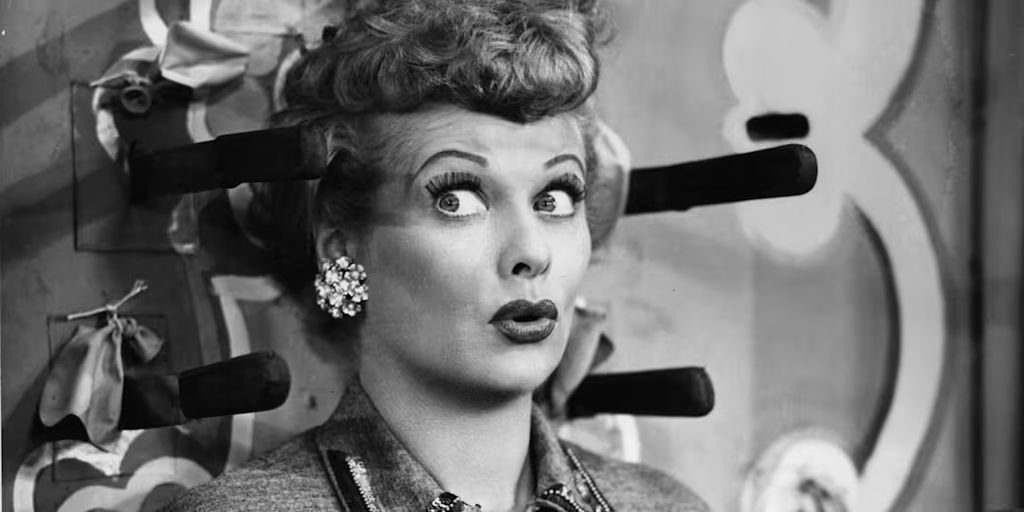
Lucille Ball remains one of the most recognizable names in television history. Best known for her unforgettable performance as Lucy Ricardo in I Love Lucy, the legendary comedian helped transform American sitcoms through her physical comedy, expressive face and remarkable instinct for turning everyday situations into hilarious television moments. Her influence, however, extended far beyond the screen.
Behind the familiar red hair and playful personality was a determined performer who spent years building her career, overcoming professional setbacks and challenging expectations in the entertainment industry. Ball became a successful film actress, a television pioneer and a powerful businesswoman at a time when women rarely occupied the industry’s most influential positions.
Her work helped establish production practices that shaped television for decades, while her business decisions contributed to the growth of one of Hollywood’s most important independent production companies. Even long after her death, her performances continue to reach new audiences through reruns, streaming services and television retrospectives.
From her early ambitions in Hollywood to her groundbreaking work behind the camera, here are six surprising facts about Lucille Ball’s life and career that reveal why her legacy remains so important.
1. Lucille Ball Spent Years Trying to Become a Hollywood Star
Before becoming a television icon, Lucille Ball worked hard to establish herself in Hollywood. Born on August 6, 1911, in Jamestown, New York, she developed an interest in performing while still young. Her path to success, however, was neither immediate nor straightforward.
As a teenager, Ball attended a drama school in New York City, where she hoped to develop her acting abilities. One of her fellow students was Bette Davis, who would later become one of Hollywood’s most celebrated dramatic actresses. Ball did not achieve the same early recognition, and her initial experiences in the performing arts were challenging.
She eventually moved toward modeling and acting opportunities, working her way into the entertainment business through persistence and a willingness to take on different roles.
During the 1930s, Ball appeared in numerous films, often playing supporting characters rather than leading roles. She worked in a variety of productions, including comedies, musicals and dramas. Although she gained valuable experience, she was not immediately recognized as a major star.
Ball’s early career earned her the nickname “Queen of the B’s,” a reference to her appearances in numerous low-budget films. The label reflected the kind of opportunities available to her at the time, but it also demonstrated how much work she put into learning the industry before achieving widespread fame.
Those years helped Ball develop a versatile screen presence. She learned how to deliver lines effectively, react to other performers and use facial expressions to communicate humor. Her experience in front of movie cameras would later prove invaluable when she moved into television.
Her journey is a reminder that even some of entertainment’s most enduring legends experienced years of uncertainty before finding the roles that made them famous.
2. She Was Not Originally Expected to Become a Comedy Superstar
Today, Lucille Ball is closely associated with physical comedy, but her early career did not immediately establish her as a television comedian.
During her years in Hollywood, Ball appeared in a wide range of films and frequently played attractive supporting characters. Although she had a natural sense of humor, the industry did not initially build her career around the comic talents that would eventually make her legendary.
Radio helped change that trajectory.
In the late 1940s, Ball starred in the radio comedy My Favorite Husband, playing Liz Cooper, a woman whose everyday experiences frequently led to amusing complications. The program became successful and gave Ball an opportunity to develop a comedic character over time.
The radio show’s popularity also helped demonstrate that audiences enjoyed hearing Ball deliver jokes and react to absurd situations. Her performance created a foundation for the television role that would define her career.
When television executives considered adapting My Favorite Husband for the new medium, Ball wanted her real-life husband, Cuban bandleader Desi Arnaz, to play her on-screen husband. The proposal initially faced resistance because executives were uncertain whether audiences would accept an American woman and a Cuban man as a married couple.
Rather than abandon the idea, Ball and Arnaz took their act on the road, performing together for live audiences. Their success helped demonstrate that their chemistry could work beyond the radio format.
That determination eventually contributed to the creation of I Love Lucy, which premiered in 1951.
The program transformed Ball from a familiar Hollywood performer into one of the biggest stars in American entertainment. Her ability to combine precise timing with exaggerated physical reactions made her performances instantly memorable.
The contrast between her earlier film roles and her eventual television success shows how a performer can discover a defining talent later in a career.
3. I Love Lucy Helped Change the Way Television Was Produced
One of the most important facts about Lucille Ball is that her impact on television extended beyond her performance. Through her work with Desi Arnaz and Desilu Productions, she helped popularize production methods that became central to American sitcoms.
When I Love Lucy was being developed, Arnaz played a major role in shaping how the show would be filmed. Rather than relying on the production methods commonly used for television at the time, the team pursued a format that could preserve the energy of a live performance while delivering a polished picture.
The series was filmed in front of a studio audience using multiple cameras. This approach allowed performers to play scenes with the rhythm of a stage production while giving editors different angles from which to assemble the finished episode.
The use of multiple cameras was not entirely new, but I Love Lucy helped establish the method as a highly successful model for situation comedies.
The show was also filmed on 35mm film, providing a high-quality image and making it possible to preserve episodes for future distribution. That decision was especially significant as television reruns became an increasingly valuable part of the entertainment business.
Ball’s influence came through her willingness to support a production system that could serve both the creative needs of the performers and the commercial future of the program.
The format helped make I Love Lucy suitable for repeated viewing, allowing new generations to discover the series long after its original broadcasts.
Modern sitcoms have adopted different technologies and production techniques, but many still rely on approaches associated with the classic multi-camera format.
Ball’s achievement was not simply making audiences laugh. Through the show she helped create, she contributed to a production model that would influence television comedy for decades.
4. Lucille Ball Became a Major Force Behind the Camera
Lucille Ball’s reputation as a performer sometimes overshadows her accomplishments as a businesswoman. Yet her work behind the camera was one of the most consequential parts of her career.
Desilu Productions, founded by Ball and Arnaz, became a major television production company. The business initially supported their own projects, but it eventually expanded into a powerful operation producing programming for other networks and audiences.
Ball’s role became particularly important after her divorce from Arnaz in 1960. She purchased his remaining interest in Desilu, becoming the company’s principal owner and taking on a greater leadership role.
In 1962, Ball became the first woman to head a major television production studio. The achievement was significant in an industry where executive power was overwhelmingly concentrated in men’s hands.
Running a production company required skills that went well beyond acting. Decisions involved budgets, staffing, development, contracts and the complicated process of getting television programs made and distributed.
Ball’s willingness to assume those responsibilities demonstrated that she understood the business side of entertainment as well as its creative demands.
Desilu was associated with a number of important television productions, including Star Trek and Mission: Impossible. Its work helped shape popular television during a period of rapid growth and experimentation.
Ball’s contribution should not be reduced to the fact that she was a famous actress who owned a company. She was involved in a business that had to evaluate projects, manage production risks and make decisions about which stories deserved a chance.
Her leadership challenged traditional expectations about women’s roles in Hollywood and helped establish her as a pioneer in television management.
In 1967, Ball sold Desilu to Gulf+Western, the parent company of Paramount Pictures at the time. The sale marked the end of her direct ownership of the studio, but her impact on its history remained substantial.
5. Desilu Helped Bring Some of Television’s Most Influential Shows to Audiences
Desilu Productions became associated with several programs that left lasting marks on American popular culture. Although Ball is most closely linked to comedy, the company’s reach extended into science fiction, crime drama and other genres.
Among its most famous productions was Star Trek, the science-fiction series created by Gene Roddenberry that premiered in 1966. The original series imagined a future in which humans traveled through space, encountered unfamiliar civilizations and confronted questions about morality, cooperation and society.
The program initially faced commercial challenges and was canceled after three seasons. Its long-term influence, however, was enormous. The Star Trek franchise eventually expanded into additional television series, films, books and other media.
Desilu was also associated with Mission: Impossible, a spy series built around secret assignments, elaborate plans and teams of specialists. The show premiered in 1966 and became one of the era’s best-known action dramas.
These projects demonstrated the company’s willingness to work across genres rather than remain limited to the kind of comedy that had made Ball famous.
The production of ambitious television programs required financial commitment and confidence in creative teams. Science fiction, in particular, could demand elaborate sets, visual effects and imaginative storytelling that differed substantially from a domestic sitcom.
Desilu’s involvement in these productions helped create opportunities for programs that later became important parts of television history.
It would be inaccurate to attribute every creative decision or success at the studio to Ball personally. Television production depended on writers, directors, actors, producers and many other professionals. Nevertheless, her leadership as the company’s owner placed her in a position to influence its overall direction.
Her legacy therefore includes not only the performances that made audiences laugh but also the broader range of entertainment produced under the company’s name.
6. Lucille Ball’s Influence Continued Long After Her Death
Lucille Ball died on April 26, 1989, at the age of 77, following surgery for an aortic aneurysm. Her death marked the end of a remarkable life, but it did not diminish the cultural importance of her work.
Decades later, I Love Lucy remains a defining example of classic American television comedy. Its episodes continue to be shown to audiences who were not alive when the series originally aired.
The show’s humor often centered on recognizable human experiences: wanting attention, trying to impress others, making ambitious plans and becoming trapped in increasingly ridiculous situations. Ball’s physical performances gave those familiar problems an exaggerated comic energy that still appeals to viewers.
Her expressive face and willingness to commit fully to a joke made her an unusually effective performer. Whether she was struggling through a chaotic situation or attempting to conceal a mistake, she could communicate a character’s feelings without relying entirely on dialogue.
Ball’s influence can also be seen in the careers of later television comedians who use physical expression, timing and character-driven humor to build a scene.
Beyond comedy, her career remains significant as an example of a woman who exercised real power in a major entertainment business. Her leadership at Desilu demonstrated that a performer could also become an influential executive responsible for decisions affecting an entire production operation.
That achievement continues to matter in discussions about women’s representation in Hollywood leadership.
Ball received numerous honors during her career, including multiple Emmy Awards. Her performances and contributions to television have also been recognized through tributes, retrospectives and continued interest in her life.
Her legacy is not limited to nostalgia. The production methods associated with I Love Lucy, the programs developed by Desilu and the example she set as a business leader remain important parts of television history.
Why Lucille Ball Remains a Television Legend
Lucille Ball’s story is more complex than the image of a beloved sitcom star. She was a performer who spent years building her career, a comedian who found her defining role through television and a businesswoman who helped shape the industry from behind the scenes.
Her success was built on persistence, creativity and a willingness to challenge expectations. She did not become a household name overnight, and her career evolved through several different stages before she reached the level of fame associated with I Love Lucy.
Her partnership with Desi Arnaz helped create one of television’s most influential sitcoms. Their work also demonstrated how production decisions could affect a program’s longevity and commercial value.
As the head of Desilu, Ball moved beyond performing to become a major decision-maker in Hollywood. Her involvement with a company responsible for important television productions expanded her influence well beyond the comedy genre.
The six facts explored here reveal different sides of her life: the aspiring actress, the developing comedian, the television innovator, the studio executive, the supporter of ambitious programming and the cultural figure whose work continues to reach new audiences.
Together, they explain why Ball remains an essential name in entertainment history.
Conclusion
Lucille Ball’s career offers a powerful example of how talent and determination can reshape an industry. Best remembered for bringing Lucy Ricardo to life, she also helped establish television production practices, led a major Hollywood studio and contributed to the development of programs that became cultural landmarks.
Her early struggles make her success even more remarkable. The performer who once appeared in supporting roles eventually became one of the most influential women in television, both on-screen and behind the camera.
More than three decades after her death, Ball’s comedy continues to entertain viewers, while her business achievements remain an important part of the history of American television.
Her legacy endures because she did more than create memorable moments. She helped change how television was made, who could lead a production company and what a successful entertainment career could look like.