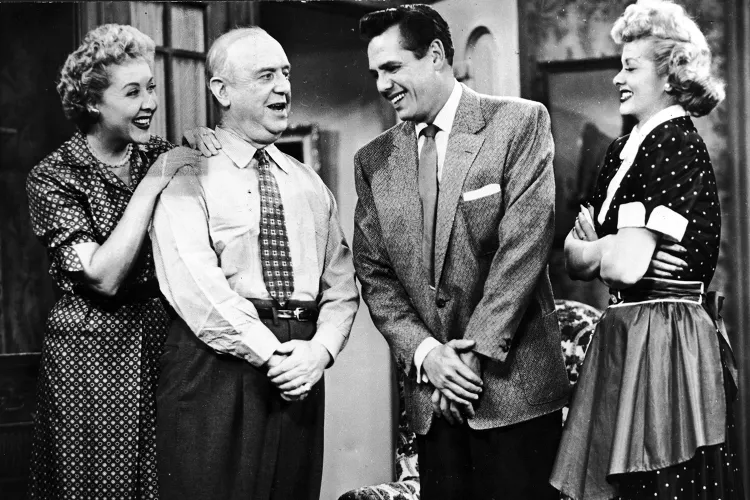
Few television comedies have achieved the lasting influence of I Love Lucy. Starring Lucille Ball and Desi Arnaz, the beloved sitcom transformed American television with its memorable characters, physical comedy, and carefully constructed jokes. Although audiences remember Lucy Ricardo’s hilarious schemes and Ricky Ricardo’s exasperated reactions, the show’s success was built on more than the chemistry between its two leading stars. Behind the laughter was a creative partnership shaped by discipline, careful planning, and a shared understanding of what made comedy work.
Ball and Arnaz were not only the stars of I Love Lucy but also central figures in the production decisions that helped establish its distinctive style. Their approach to humor emphasized preparation, timing, and the importance of making every scene work for the audience. The rules they followed when developing jokes reflected a larger philosophy: comedy could feel spontaneous and unpredictable on screen while remaining carefully organized behind the scenes.
Arnaz, who played bandleader Ricky Ricardo, understood that a successful sitcom needed more than funny dialogue. The characters had to feel believable, the situations had to build naturally, and the performers needed room to deliver their lines and physical reactions effectively. These principles helped I Love Lucy become one of the defining television comedies of its era.
How I Love Lucy Changed Television Comedy
When I Love Lucy premiered in 1951, television was still developing its identity as a major entertainment medium. Sitcoms existed, but production methods were not yet standardized across the industry. Ball and Arnaz helped demonstrate that television comedy could benefit from the structure, consistency, and visual quality associated with more ambitious productions.
The series followed Lucy Ricardo, a determined and imaginative housewife who regularly found herself at the center of elaborate comic situations. Her husband, Ricky, was a Cuban American bandleader whose attempts to maintain order frequently collided with Lucy’s ambitions. Their neighbors, Fred and Ethel Mertz, played by William Frawley and Vivian Vance, added another layer of humor and conflict.
The premise was simple, but its possibilities were extensive. Lucy might attempt to enter show business, devise a questionable plan to make money, or become involved in an increasingly chaotic domestic situation. The humor often emerged from the contrast between her confidence and the consequences of her decisions.
What made these stories memorable was their construction. A seemingly ordinary situation could develop through a series of misunderstandings, escalating complications, and perfectly timed reactions. Rather than relying exclusively on witty dialogue, the show frequently used physical comedy to communicate what the characters were feeling.
Ball was especially skilled at this style of performance. Her facial expressions, gestures, and ability to turn an ordinary movement into a comic moment gave Lucy a distinctive personality. Arnaz complemented her with a more controlled performance style, allowing Ricky’s frustration and affection to become part of the joke.
Their differences created a productive comic partnership. Lucy generated much of the chaos, while Ricky often served as the person trying to make sense of it. The tension between those approaches gave the writers and performers a dependable foundation for building episodes.
Desi Arnaz’s Belief in Carefully Structured Humor
Arnaz’s contribution to I Love Lucy extended well beyond his role as an actor. As a producer and business partner, he helped shape the way the series was made and presented to viewers.
One of the show’s most important strengths was its commitment to preparation. Comedy can appear effortless when a performer delivers a line at precisely the right moment, but achieving that effect usually requires substantial work. Writers must build the situation, actors must understand the rhythm of the scene, and production teams must ensure that the visual elements support the joke.
Arnaz recognized that a sitcom depended on this coordination. A joke could be clever on paper but ineffective if the audience did not understand the setup or if the performer rushed the punchline. Similarly, a physical gag needed enough time to develop for viewers to appreciate the absurdity of what was happening.
This emphasis on structure did not make the show less creative. Instead, it provided a framework within which the performers could be expressive. Ball could exaggerate Lucy’s reactions, and Arnaz could respond with disbelief, irritation, or affection without losing the underlying logic of the scene.
The best comedy in I Love Lucy often followed a clear progression. Lucy would establish a goal, make a questionable decision, and attempt to conceal the resulting problem. Each effort to fix the situation would create another complication until the story reached an increasingly ridiculous conclusion.
That structure gave audiences something to anticipate while still allowing room for surprise. Viewers could understand why Lucy acted as she did, even when they knew her plan was unlikely to succeed.
Arnaz’s approach also reflected a broader understanding of television as a collaborative medium. A successful joke was not simply the responsibility of the person delivering the punchline. It depended on writing, acting, directing, editing, and the timing of the entire production.
The Importance of Keeping Jokes True to the Characters
One of the reasons I Love Lucy has remained popular is that its humor is closely connected to the personalities of its characters. Lucy is funny because she is ambitious, impulsive, and convinced that she can accomplish almost anything. Ricky’s reactions work because he knows Lucy well but cannot always prevent her from turning an ordinary day into a disaster.
The show’s comic situations generally grow out of those established traits. Lucy’s desire for attention and opportunity drives many of her schemes, while Ricky’s professional responsibilities and attempts to maintain household order provide the opposition she must overcome.
This consistency helps make even the most exaggerated scenes understandable. Audiences may not believe that a real person would behave exactly as Lucy does, but they recognize the emotional logic behind her actions. She wants to be included, prove herself, or achieve something beyond her usual domestic routine.
Her determination can be admirable even when her plans are disastrous. The audience laughs at the results while often sympathizing with the desire that started the whole affair.
Ricky’s role is equally important. If he responded to every situation with uncontrolled anger, the relationship could become unpleasant. Instead, the show balances his frustration with signs of affection and familiarity. Their disagreements are part of a larger relationship in which both characters remain central to one another’s lives.
The supporting characters strengthen this balance. Fred and Ethel frequently become involved in Lucy’s schemes, sometimes helping her and sometimes trying to persuade her to abandon an obviously flawed idea. Their reactions provide additional perspectives on the same comic situation.
This character-driven approach gave the writers a reliable way to develop new stories without making every episode feel disconnected from the last. The jokes could change, but the personalities that produced them remained recognizable.
Why Timing Was Essential to the Show’s Success
In comedy, timing can determine whether a joke produces a laugh or passes unnoticed. A pause that lasts too long may weaken the momentum, while a reaction delivered too quickly can prevent the audience from understanding what has happened.
I Love Lucy made extensive use of this principle. Ball’s performances often depended on the space between a character’s expectation and the reality that followed. Lucy might begin a scene with absolute confidence, only to discover that her plan had gone wrong. Her expression, a brief silence, or a sudden physical reaction could communicate the entire situation without requiring additional dialogue.
Arnaz’s performance style helped create contrast. Ricky’s restrained reactions often made Lucy’s behavior seem even more outrageous. The humor came not only from what Lucy did but also from how the people around her responded.
The series also benefited from rehearsing and refining scenes. Repetition allowed performers to develop the physical precision required for complicated sequences, particularly those involving props, movement, or multiple characters. A scene that looked chaotic to viewers needed to be coordinated carefully to remain understandable and entertaining.
This was especially important for the show’s more elaborate physical-comedy sequences. If the audience could not follow the action, the joke would lose its impact. Every movement needed to contribute to the situation rather than simply add activity.
Ball’s physical performances became one of the series’ most recognizable features. Her willingness to appear awkward, embarrassed, or completely overwhelmed gave Lucy a comic vulnerability that audiences could understand. The character did not need to remain elegant or dignified to remain lovable.
Instead, Lucy’s willingness to make a fool of herself became part of her appeal. Her failures were exaggerated, but her determination to try again made her feel familiar.
The Production Decisions That Helped Make the Series Different
Arnaz’s influence on the show’s production methods was another major part of its legacy. Rather than treating I Love Lucy as a disposable weekly performance, he helped develop an approach designed to preserve the quality of the episodes and make the program practical to produce over time.
A major innovation was the decision to film the series in front of a live studio audience using three cameras. This method, associated with cinematographer Karl Freund and the production team, allowed the show to capture performances from multiple angles while retaining the energy of a live comedy performance.
The arrangement offered several advantages. The actors could perform for an audience, whose laughter provided immediate feedback, while the cameras recorded the scene from different perspectives. The production team could then select the most effective shots when assembling the finished episode.
The series was also filmed on 35mm film rather than relying solely on the lower-quality live broadcast techniques common at the time. This helped preserve a high-quality master that could be used for later broadcasts.
The production approach supported the show’s comedy because it gave the performers a consistent environment in which to work. Complex scenes could be rehearsed, coordinated, and recorded with greater control than a live broadcast would typically allow.
Arnaz also helped establish Desilu Productions as an important force in television. The company became associated with influential programs and played a role in the development of the American television industry.
These accomplishments demonstrate why Arnaz should be remembered as more than the man who played Ricky Ricardo. His business judgment and production decisions helped create the conditions in which Ball’s performance and the writers’ material could reach a wide audience.
Lucille Ball’s Creative Instincts Were Equally Important
Although Arnaz’s production expertise was crucial, the success of I Love Lucy cannot be separated from Ball’s comic instincts. She had developed her performance skills through years of work in entertainment before becoming one of television’s most recognizable stars.
Ball understood how to make a character’s emotions visible. Lucy could communicate excitement, suspicion, embarrassment, or determination through her body language before she spoke a word. That ability was particularly valuable in a medium where viewers might be watching from different distances or paying attention to several elements on screen.
Her physical comedy also required discipline. A convincing fall, exaggerated expression, or carefully timed movement needed to be executed precisely. The apparent spontaneity of Lucy’s behavior was often the result of rehearsal and performance experience.
Ball also understood that comedy worked best when audiences cared about the character. Lucy could be foolish, manipulative, or stubborn, but she was rarely presented as simply malicious. Her schemes often came from a desire to participate in the world around her, even when she chose the wrong way to do it.
That combination of ambition and vulnerability helped audiences identify with her. Lucy’s mistakes were funny because they were recognizable in spirit, even when their consequences were extraordinary.
The relationship between Ball and Arnaz allowed their different strengths to reinforce one another. Ball brought extraordinary performance instincts, while Arnaz contributed production knowledge and a practical understanding of the television business. Together, they helped build a show that was both entertaining and influential.
Their personal relationship eventually ended in divorce in 1960, but the creative legacy of their partnership continued. The series remained popular through reruns and became an enduring example of how a television comedy could connect with audiences across generations.
Why the Rules Behind the Jokes Still Matter
The principles associated with I Love Lucy remain relevant to comedy writers and performers today. Audiences may encounter humor through streaming platforms, short videos, social media, or traditional television, but the fundamentals of a successful joke have changed surprisingly little.
A clear setup helps viewers understand the situation. Strong characterization gives the joke a reason to exist. Timing allows the audience to recognize the surprise, while a believable emotional reaction makes the result more satisfying.
The show’s approach also illustrates the value of knowing when not to add another joke. Comedy can become less effective when every line competes for attention. A well-placed pause, a facial expression, or a simple reaction may be funnier than an additional punchline.
Another enduring lesson is that preparation can support spontaneity rather than destroy it. Performers who understand a scene’s structure have more freedom to deliver their lines naturally and respond to their fellow actors. The audience experiences the result as lively and unpredictable, even when the production has been carefully organized.
Arnaz’s business and technical decisions were important for the same reason. A well-designed production process gave the cast and writers a stable foundation. The series could focus on creating entertaining stories because its underlying methods were designed to support consistent results.
The combination of strong writing, skilled acting, precise timing, and innovative production helped I Love Lucy become more than a successful sitcom. It became a model for generations of television comedies.
The Lasting Legacy of Desi Arnaz and Lucille Ball
More than seven decades after its debut, I Love Lucy continues to introduce new audiences to Lucy Ricardo’s schemes and Ricky Ricardo’s memorable reactions. The situations may reflect the social expectations of the 1950s, but the basic comic patterns remain easy to understand.
People still recognize the urge to prove oneself, the temptation to conceal a mistake, and the way one bad decision can lead to several more. Those familiar experiences helped make the show’s humor accessible to viewers who lived in a very different era from its original audience.
The show’s lasting success also reflects the partnership between Ball and Arnaz. Their work demonstrated that television comedy could combine memorable performances with thoughtful production choices and a disciplined approach to storytelling.
The rules behind the jokes were not simply restrictions on creativity. They helped establish the rhythm, clarity, and consistency that allowed the humor to flourish. By building comedy around recognizable characters and carefully developed situations, the show created moments that could remain funny long after their original broadcast.
Arnaz’s contributions as a performer, producer, and business leader helped shape the program’s production identity. Ball’s comic imagination gave it a central character whose ambition and mistakes continue to entertain viewers.
Together, they created a television legacy that reaches beyond individual episodes or famous punchlines. I Love Lucy showed that comedy could be both carefully constructed and wonderfully unpredictable.
That may be the most enduring lesson behind the show’s success: the laughter may appear effortless, but the best comedy is often built on preparation, collaboration, and a clear understanding of what makes people laugh.