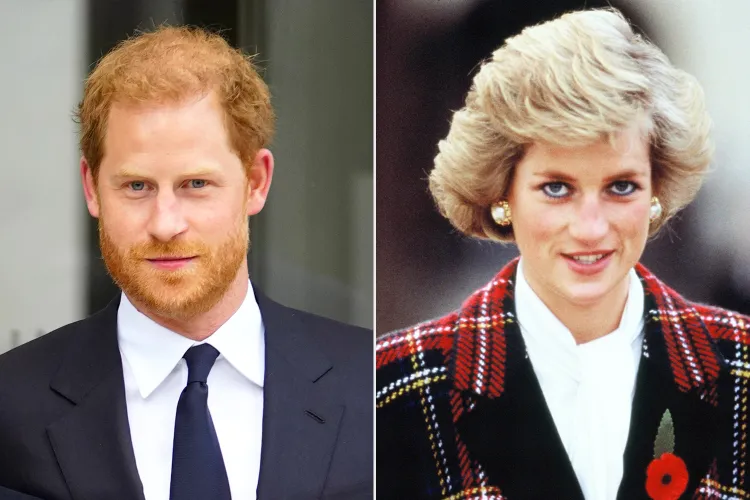
Prince Harry has shared an intimate glimpse into his enduring connection with his late mother, Princess Diana, revealing the deeply personal question he often asks himself when looking at one of her photographs. In a recent conversation about grief, memory, and emotional healing, the Duke of Sussex explained how a particular portrait allows him to feel connected to the mother he lost when he was just 12 years old.
The photograph, taken by renowned French photographer Patrick Demarchelier for a December 1995 issue of Harper’s Bazaar, holds a special place in Harry’s life. Looking at Diana’s expression, particularly the playful quality he sees in her smile, prompts him to wonder what she would think of the person he has become and the choices he makes today.
His question is simple but profoundly personal: What would his mother think about what he is doing right now?
The revelation came during Redefining Grief: Building Resilience Through Loss, a MasterClass conversation featuring Harry and neuroscientist Dr. Mary-Frances O’Connor. Released in October 2026, the discussion explores the lasting effects of bereavement and the ways people can learn to live with loss without allowing it to define every part of their lives.
For Harry, the conversation offers another opportunity to discuss a subject that has shaped much of his personal journey. His mother’s death remains an important part of his story, but his reflections also reveal how memories, family connections, and a changing understanding of grief can help someone find a path forward.
The Photograph of Princess Diana That Keeps Her Close
Not every photograph carries the same emotional significance. For Prince Harry, the portrait of Diana taken in 1995 has become a particularly meaningful reminder of the woman he remembers as his mother.
In the MasterClass conversation, Harry described the feeling of looking into her eyes and noticing what he interprets as a playful quality in her smile. He explained that the image makes him feel connected to her, even though decades have passed since her death.
The portrait is more than a historical image of one of the most photographed women in the world. It represents a personal connection that Harry continues to revisit as he navigates adulthood, marriage, fatherhood, and the responsibilities that come with his public role.
Harry has also described looking at the photograph to see whether Diana’s facial expression appears to change. Of course, a photograph remains still, but the experience of looking at it can change as a person’s thoughts and circumstances evolve.
A familiar expression may suggest something different at different stages of life. A smile that once seemed simply cheerful might later evoke a memory, a question, or a feeling that is difficult to put into words.
That may be part of what makes this particular image so meaningful to Harry. It allows him to focus on his mother’s face rather than on the circumstances surrounding her death.
The photograph cannot answer his questions, but it gives him a place to direct them. In that sense, the portrait becomes a personal reminder of a relationship that continues to matter, even though it can no longer develop through ordinary conversations and shared experiences.
The Question Harry Asks His Late Mother
Harry’s reflection centers on a question that many people who have lost a parent may recognize in their own way: What would that person think of the life I am living now?
When Harry looks at Diana’s photograph, he wonders what she might think about what he is doing at that moment. The question connects his present life with the mother whose guidance he lost during childhood.
It is not necessarily a request for approval in a simple sense. Rather, it reflects the natural desire to imagine how a loved one might respond to the decisions, relationships, and challenges that shape the years after their death.
For someone who loses a parent at a young age, many milestones arrive without the opportunity to share them directly. Graduation, career changes, marriage, the birth of children, and major personal decisions may all become occasions when the absence of that parent feels especially noticeable.
Harry has experienced many such milestones in public view. He became an adult under intense media attention, built a life beyond his childhood role within the royal family, married Meghan Markle, and became a father to Prince Archie and Princess Lilibet.
His question invites reflection on how he understands those experiences in relation to Diana’s memory. Rather than claiming to know what his mother would say, he appears to be exploring how her remembered personality and the relationship they shared continue to influence his own perspective.
That distinction is important. No one can know precisely what Diana would think about every decision her son has made. But the act of imagining her response can still offer comfort, perspective, and a way to remain connected to the values and memories associated with her.
For Harry, the photograph provides a quiet space in which to consider that relationship without needing a definitive answer.
Prince Harry’s Lifelong Journey Through Grief
Princess Diana died in a car crash in Paris on August 31, 1997, when Harry was 12 years old. Her death shocked people around the world, but for her sons, Prince William and Prince Harry, the loss was first and foremost a deeply personal family tragedy.
The public witnessed the funeral and the enormous outpouring of grief that followed. Yet the images of the young princes walking behind their mother’s coffin could never communicate the full emotional experience of losing a parent.
Harry has discussed the difficulties he experienced in the years after Diana’s death, including periods when he struggled to confront painful memories. In his recent reflections, he has described how grief affected his ability to remember aspects of his mother’s voice, laughter, and appearance.
Such experiences illustrate that grief is not always a continuous, clearly understood emotion. People may feel numb, avoid reminders of a loss, or struggle to access memories that once seemed vivid. Others may find that memories return unexpectedly through photographs, familiar scents, music, or conversations.
Harry has previously spoken about how the scent of his mother’s perfume helped him reconnect with memories. Smell is closely associated with memory and emotion, which may explain why a familiar fragrance can evoke a powerful sense of someone’s presence.
His comments also highlight the difference between remembering the circumstances of a death and remembering the person who died. The former can be painful and overwhelming, while the latter may contain warmth, humor, affection, and details of ordinary family life.
For Harry, reconnecting with Diana’s image appears to be part of a broader effort to understand his grief and preserve a relationship with his memories of her.
Why the Loss of a Parent Can Shape a Lifetime
Losing a parent during childhood can influence how a person understands relationships, security, and the future. The effects vary considerably, and there is no single emotional path that applies to everyone.
For some people, grief becomes particularly noticeable around birthdays, anniversaries, or major family milestones. For others, it may emerge unexpectedly during ordinary moments, such as seeing a photograph or hearing a familiar voice.
Harry’s reflections illustrate how the relationship with a deceased parent can remain meaningful throughout adulthood. His memories of Diana are connected not only to his childhood but also to the person he is now.
As children grow older, they may reinterpret memories of their parents through the experiences they accumulate themselves. A moment that seemed confusing at 12 may take on a different meaning at 30 or 40. Becoming a parent can also change how someone thinks about their own childhood and the person who raised them.
Harry’s experience of fatherhood may provide new perspectives on the relationship he had with Diana. However, it would be speculative to claim that any particular parenting decision or personal milestone has a single explanation rooted in his mother’s death.
What can be said is that his public reflections show a continuing interest in understanding grief rather than treating it as something that must disappear with time.
The photograph offers a way to remember Diana as a person who mattered deeply to him, not merely as a historical figure whose life and death were followed by millions.
The MasterClass Conversation About Healing and Resilience
Harry’s comments about Diana’s photograph formed part of a broader discussion in Redefining Grief: Building Resilience Through Loss. The MasterClass features the Duke of Sussex in conversation with neuroscientist Dr. Mary-Frances O’Connor, whose work focuses on grief and the brain.
The discussion explores the emotional and psychological consequences of bereavement, including the ways people respond to loss and the challenges involved in learning to live with an absence that cannot be reversed.
One important distinction in conversations about grief is the difference between moving forward and forgetting. Healing does not require someone to erase memories of a loved one or stop feeling sadness. Instead, it can involve developing a way to carry those memories while continuing to participate in life.
Harry has spoken about how difficult it was to allow himself to experience happiness after his mother’s death. He described a period when he felt that being happy could somehow conflict with the depth of his loss.
Over time, he came to understand that remembering Diana and allowing himself to experience joy were not opposing choices. He reflected on the idea that his mother would have wanted him to live a happy life rather than remain trapped by grief.
That realization, as he has described it, helped him reconsider the relationship between love and loss. Continuing to live fully does not diminish the importance of the person who died.
This perspective is relevant to many people who experience bereavement. Some may feel guilty when they begin enjoying life again, especially if the loss occurred suddenly or at a formative stage. Others may worry that emotional recovery means they are forgetting the person they loved.
Harry’s reflections suggest a different understanding: happiness can coexist with remembrance, and moving forward does not require leaving a loved one behind emotionally.
How Memory Can Keep a Loved One Present
Photographs are often among the most treasured objects people retain after a death. They preserve a moment that would otherwise exist only in memory, allowing family members to revisit a face, expression, or familiar setting.
Yet a photograph does more than record physical appearance. It can become associated with stories, personal memories, and feelings that extend beyond the image itself.
Harry’s connection to Diana’s portrait demonstrates this emotional dimension. The image captures her at a particular moment in 1995, but its meaning continues to evolve as he reflects on his own life.
For another person, a photograph might remind them of a family holiday, a parent’s sense of humor, or a conversation that took place years earlier. The image itself does not change, but the memories attached to it can become more layered over time.
This is one reason photographs can be both comforting and painful. They offer a tangible reminder of someone who is gone, while also emphasizing the fact that the person can no longer be reached in the ordinary way.
Harry’s habit of looking at Diana’s photograph and wondering what she might think reflects this tension. The image provides a sense of closeness, but it cannot replace a real conversation.
Rather than suggesting that photographs can resolve grief, his experience shows how they may become part of an ongoing relationship with memory.
Princess Diana’s Legacy Beyond the Royal Family
More than 29 years after her death, Princess Diana remains a significant figure in public memory. Her charitable work, public presence, and approach to people experiencing hardship helped shape the way many people remember her.
Her sons have also spoken about the influence she had on their lives. Both have continued to carry memories of their mother into adulthood, although each person’s experience of grief and remembrance is individual.
For Harry, Diana’s legacy is closely connected to his personal story and his efforts to discuss mental health and emotional well-being. He has spoken publicly about the difficulties of processing loss and the importance of seeking support when emotional pain becomes overwhelming.
His openness can help encourage conversations about bereavement, particularly among people who feel pressure to hide their emotions or believe that grief should follow a predictable timetable.
At the same time, Diana’s legacy is larger than any one family member’s memories. Her charitable work and public influence continue to be discussed independently of her sons’ personal experiences.
Remembering her respectfully means allowing room for both dimensions: the public figure whose life affected millions and the mother whose absence profoundly changed the lives of her children.
Harry’s photograph provides a glimpse into the latter. It reminds audiences that behind the historical images and public tributes was a family relationship that cannot be reduced to a royal title or a news headline.
Finding Happiness Without Forgetting the Past
One of the most moving themes in Harry’s recent reflections is the idea that grief and happiness do not have to compete with one another.
For people who have lost someone important, happiness can sometimes feel complicated. A special occasion may bring joy alongside sadness because the absent person cannot be there to share it. A new family milestone may create excitement while also intensifying the awareness of what has been lost.
These mixed emotions do not necessarily mean that someone is failing to heal. They can reflect the continuing importance of the relationship.
Harry’s understanding that Diana would have wanted him to find happiness helped him reconsider the idea that suffering was necessary to prove his love. That perspective offers a meaningful distinction between remembering someone and remaining permanently defined by the pain of losing them.
The past remains part of a person’s life, but it does not have to determine every future experience.
For Harry, his marriage to Meghan, his role as a father, and his work on issues related to emotional well-being are parts of his present life. His memories of Diana can coexist with those experiences without requiring him to choose between them.
The question he asks when looking at her photograph may never have a definitive answer. But it provides an opportunity to reflect on the person she was, the relationship they shared, and the values he continues to associate with her memory.
Conclusion: A Photograph, a Question, and an Enduring Bond
Prince Harry’s revelation about the question he asks when looking at Princess Diana’s photograph offers a deeply personal insight into the lasting nature of grief.
The portrait, taken by Patrick Demarchelier for a December 1995 issue of Harper’s Bazaar, reminds Harry of his mother’s expression and helps him feel connected to her. Looking at the image, he wonders what she would think about what he is doing today.
The question cannot be answered with certainty, but that may not be its purpose. It allows Harry to reflect on his choices, revisit his memories, and maintain an emotional connection with someone whose life ended when he was still a child.
His account also highlights an important lesson about bereavement: healing does not mean forgetting, and finding happiness does not diminish the love someone feels for a person who has died.
Through his discussion of grief with Dr. Mary-Frances O’Connor, Harry has helped bring attention to the complicated ways people remember those they have lost. His experience shows that a photograph can become more than a record of the past. It can serve as a reminder of love, a prompt for reflection, and a quiet connection between childhood memories and adult life.
For Harry, Princess Diana’s photograph preserves a familiar smile. The question he asks while looking at it reflects something even more enduring: the desire to understand how a beloved parent might see the person their child has become.