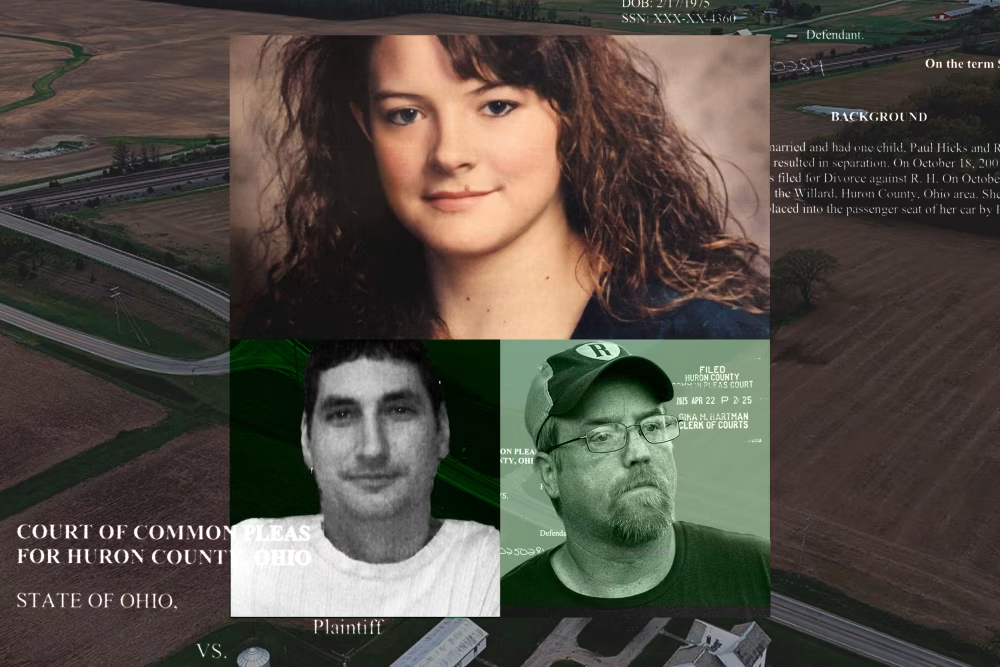
For nearly a quarter of a century, Steve Gates remained silent about what he said he witnessed the night Regina Rowe-Hicks disappeared. Fear, threats, and a secret that weighed on his conscience kept him from telling investigators the full story. Then, as a renewed investigation brought the case back into focus, Gates finally came forward. His testimony helped convict Regina’s estranged husband, Paul Hicks, in a murder that had remained unsolved since 2001.
The death of Regina Rowe-Hicks haunted her family for more than two decades. The 25-year-old mother disappeared in October 2001 after leaving to collect her young son. Four days later, her body was discovered inside her submerged white Chevrolet Camaro in a pond in Willard, Ohio.
For years, investigators struggled to establish exactly what had happened. Suspicion surrounded the people closest to Regina, but the evidence available at the time was insufficient to bring the case to trial.
That changed when investigators revisited the cold case and reexamined witness accounts. At the center of the breakthrough was Steve Gates, a longtime friend of Paul Hicks who eventually described what he said happened on the night Regina disappeared.
In 2025, Paul Hicks was convicted of murder and related charges. In January 2026, he was sentenced to 25 years to life in prison.
The conviction brought a major development in a case that had troubled Regina’s loved ones for years. But it also raised another difficult question: Why had a witness who claimed to know what happened waited so long to speak?
Regina Rowe-Hicks Disappeared on an October Night
Regina Rowe-Hicks was a young mother whose life was cut short under circumstances that would remain unclear for decades. She had married Paul Hicks after the two began dating in high school, and they shared a son, Montana.
By 2001, their relationship had deteriorated, and they were estranged. According to court records reported during the investigation, Paul filed for divorce the day after Regina disappeared.
On October 18, 2001, Regina left her boyfriend’s home in her white Chevrolet Camaro. She was expected to collect her four-year-old son from a property connected to Steve Gates, who was friends with Paul.
She never arrived as expected.
The disappearance quickly became a frightening mystery for her relatives. Regina was still a young woman with a child who depended on her, and the uncertainty surrounding her whereabouts left her family desperate for answers.
Four days later, investigators found her body inside the Camaro at the bottom of a nearby pond.
Authorities determined that Regina had suffered blunt-force trauma to the head. The discovery transformed a missing-person investigation into a homicide case, but finding her body did not immediately reveal who was responsible.
Investigators had to reconstruct the final hours of her life, establish who had seen her that night, and determine how her vehicle ended up underwater.
Those questions would remain unresolved for almost 24 years.
The Witness Who Knew More Than He Told Police
Steve Gates was not a stranger who happened to appear in the investigation. He was a friend of Paul Hicks, and the property where Regina was expected to collect her son was associated with him.
That connection made his account potentially important to understanding what happened.
According to Gates’s later testimony, Regina arrived that evening and became involved in an argument with Paul. Gates told investigators that he found Regina unconscious and that Paul told him she was dead.
Gates further said that Paul placed Regina in the passenger seat of the Camaro, drove the vehicle into the pond, and got out before it sank, leaving Regina inside.
These were serious allegations, and they became central to the prosecution’s case. They were not, however, established in court until the evidence was examined through the legal process.
For years, Gates had not provided investigators with the full account that he later described. His silence meant that a potentially critical witness remained unavailable to the investigation in the form needed to move the case forward.
The delay became one of the most troubling aspects of the story. If the account Gates eventually gave was true, he had carried knowledge of the events for decades while Regina’s family continued searching for answers.
His eventual decision to speak would help change the direction of the case.
Why Did Steve Gates Stay Silent for 24 Years?
In a later interview with Dateline, Gates explained that fear played a major role in his decision to remain silent. He said he had endured threats and spent years worrying about what Paul Hicks might do.
Gates described being tired of the intimidation and of constantly looking over his shoulder. He told correspondent Keith Morrison that the threats had continued over the years, although he acknowledged that he had not documented them particularly well with law enforcement.
According to Gates, the fear was not an isolated concern. It had become part of his life, influencing how he thought about his safety and whether he could safely disclose what he knew.
Remaining silent may have felt like a way to avoid further danger. But silence also meant living with the unresolved memory of a night that would become the subject of a major homicide investigation.
Gates eventually said he wanted to clear his conscience. His health was also a factor: reporting on the Dateline interview described him as living with a life-threatening kidney disease. The combination of fear, the passage of time, and an awareness of his own mortality appears to have contributed to his decision to come forward.
His explanation does not erase the significance of his earlier silence. Nor does it mean that investigators or the public must accept every part of his account without scrutiny.
Instead, it helps explain the difficult circumstances surrounding a witness whose information became crucial only after years of withholding it.
The decision to speak ultimately placed Gates at the center of a case that had long seemed impossible to resolve.
A Cold Case Gets a New Chance
For years, investigators faced a major obstacle: they lacked sufficient evidence to definitively connect Paul Hicks to Regina’s death.
The discovery of Regina’s body and the circumstances of the disappearance raised urgent questions, but suspicion alone could not establish criminal responsibility. Investigators needed evidence that could support charges and withstand a trial.
A renewed cold-case review eventually changed the situation. Investigators with the Ohio Attorney General’s Office Bureau of Criminal Investigation revisited the case and began reinterviewing people who might have information about the night Regina disappeared.
The review demonstrated why old cases sometimes require a fresh examination. Witnesses may provide new accounts, inconsistencies in earlier statements may become more significant, and information that once seemed incomplete may take on a different meaning when considered alongside other evidence.
The renewed attention also helped bring the case back into public view. Coverage of Regina’s disappearance and the work of people seeking answers encouraged further interest in a homicide that had remained unresolved for decades.
Gates eventually gave investigators the account that became a crucial part of the prosecution’s case.
His cooperation was not without legal complications. Authorities granted him immunity in exchange for his testimony, a decision that allowed prosecutors to present his evidence while also making the circumstances of his cooperation relevant to the jury’s assessment of his credibility.
The case was no longer limited to the unanswered questions of 2001. Investigators now had a witness prepared to describe what he said he had seen.
The Challenge of Building a Case Without Forensic Evidence
The prosecution faced a difficult task. Reports from the trial emphasized that the case did not rely on DNA or other direct forensic evidence tying Paul Hicks to Regina’s murder.
Instead, prosecutors relied heavily on Gates’s account and other circumstantial evidence.
That presented an obvious challenge. A witness who had remained silent for more than two decades could be questioned about why he had not spoken sooner, whether his memory was reliable, and whether his agreement with prosecutors influenced his testimony.
The defense raised concerns about the lack of physical evidence and argued that the prosecution’s case relied on speculation rather than proof. Paul Hicks pleaded not guilty and contested the allegations.
These arguments were central to the trial because a criminal conviction requires the prosecution to establish guilt beyond a reasonable doubt. A witness’s account may be powerful, but jurors must evaluate it alongside the circumstances in which it was given and any evidence that supports or contradicts it.
Gates’s long silence was therefore not a minor detail. It was a major issue that the jury had to consider.
At the same time, the prosecution argued that his account explained what had happened to Regina and why her death had been concealed as a vehicle submerged in a pond.
After a trial lasting approximately two weeks, the jury found Paul Hicks guilty on all counts in December 2025.
The verdict marked a dramatic turning point in the investigation. A case that had remained unresolved since 2001 had finally reached a criminal conviction.
Paul Hicks Was Sentenced to 25 Years to Life
In January 2026, Paul Hicks was sentenced to 25 years to life in prison following his conviction.
The sentence brought a formal legal outcome to a case that had remained open for nearly a quarter of a century. It also represented a significant moment for Regina’s relatives, who had spent years seeking answers about her death.
Hicks’s conviction followed a prosecution that relied heavily on witness testimony and circumstantial evidence rather than a decisive forensic match. The jury’s verdict meant that the evidence presented at trial met the legal standard required for conviction.
However, the case did not bring uncomplicated relief to everyone affected by the tragedy.
Regina and Paul’s son, Montana, was an adult by the time of the sentencing. In a victim-impact statement, he described the emotional difficulty of losing his mother and facing the conviction of his father. He also expressed reservations about the evidence while acknowledging that anyone who committed a crime should be held accountable.
His response illustrates the complicated nature of justice in cases involving families. A conviction may answer an important legal question, but it can also create new emotional challenges for people who have relationships with both the victim and the person found guilty.
The court’s decision established Paul Hicks’s criminal responsibility under the law. It could not restore the years Regina’s family had spent without answers or remove the lasting effects of her death.
Hicks is appealing his conviction, according to reporting on the case. That development is an important part of the legal record, even as the verdict and sentence stand as the outcome of the trial.
Remembering Regina Beyond the Crime
In accounts shared by relatives, Regina was remembered as a warm, protective person who made others feel loved and safe. Her cousin Lisa Hersha described a woman whose personality and confidence had changed during her relationship with Paul.
Such recollections provide a different perspective from the police reports and courtroom testimony that eventually defined the investigation.
True-crime stories can become so focused on the accused, the witness, and the details of a mystery that the person who died risks becoming secondary to the case itself.
Regina was more than the subject of a cold-case investigation. She was a daughter, a relative, and a mother to a little boy who was only four when she disappeared.
Her family lost the opportunity to watch her grow older, see her son reach adulthood, and share the ordinary experiences that make up a life. For years, they also lived without a definitive legal resolution to the circumstances of her death.
The eventual conviction cannot undo that loss. But it can establish an official account of responsibility and recognize the seriousness of what happened to her.
Keeping Regina’s life at the center of the story is essential. The witness’s decision to speak and the investigation’s progress matter because they helped bring her case to trial—not because the mystery itself is more important than the woman whose life was taken.
The Lasting Impact of Speaking Out
Gates’s decision to cooperate raises difficult questions about fear, accountability, and the responsibilities of people who witness serious crimes.
Fear can be powerful, especially when a witness believes that speaking could place their own safety or the safety of loved ones at risk. The passage of time can make the decision even more complicated, as memories, relationships, and personal circumstances change.
But silence can also have lasting consequences. In Regina’s case, the delay meant that investigators and her family waited years for an account that eventually became central to a prosecution.
Gates’s testimony helped bring the case to court, but his role also illustrates why witness credibility must be examined carefully. The timing of a disclosure, the reasons for earlier silence, and any agreements made with prosecutors can all be relevant to evaluating evidence.
His story should not be reduced to either unquestioning praise or simple condemnation. His stated fear provides context, while the consequences of withholding information remain part of the case’s history.
For investigators, the outcome demonstrates the importance of revisiting unsolved cases and giving witnesses opportunities to provide information that may not have been available during the original investigation.
For families, it offers a reminder that a case can remain unresolved for years before a new lead changes its direction.
Conclusion: After 24 Years, Regina Rowe-Hicks’s Case Reached Court
Regina Rowe-Hicks disappeared on October 18, 2001, and was found dead inside her submerged car four days later. Her murder remained unsolved for nearly 24 years, leaving her family without a definitive legal answer.
The eventual breakthrough came when Steve Gates, a friend of Paul Hicks, gave investigators a detailed account of what he said happened on the night Regina disappeared. He later explained that years of threats and fear had kept him silent, while his health and desire to clear his conscience helped motivate him to speak.
His testimony became a key part of the prosecution’s case. After a trial in 2025, Paul Hicks was convicted and sentenced in January 2026 to 25 years to life in prison. He is appealing the conviction.
The case remains a painful reminder of how difficult it can be to solve a homicide when crucial information is withheld for years. It also demonstrates the importance of careful investigation, credible testimony, and the determination to revisit cases that once seemed impossible to resolve.
Above all, Regina’s story is about a young mother whose life was taken and a family that spent decades seeking answers. The verdict cannot give them back the years they lost, but it marks a significant legal conclusion to a case that remained unresolved for far too long.
After 24 years, the silence was finally broken—and Regina Rowe-Hicks’s death was brought before a jury.