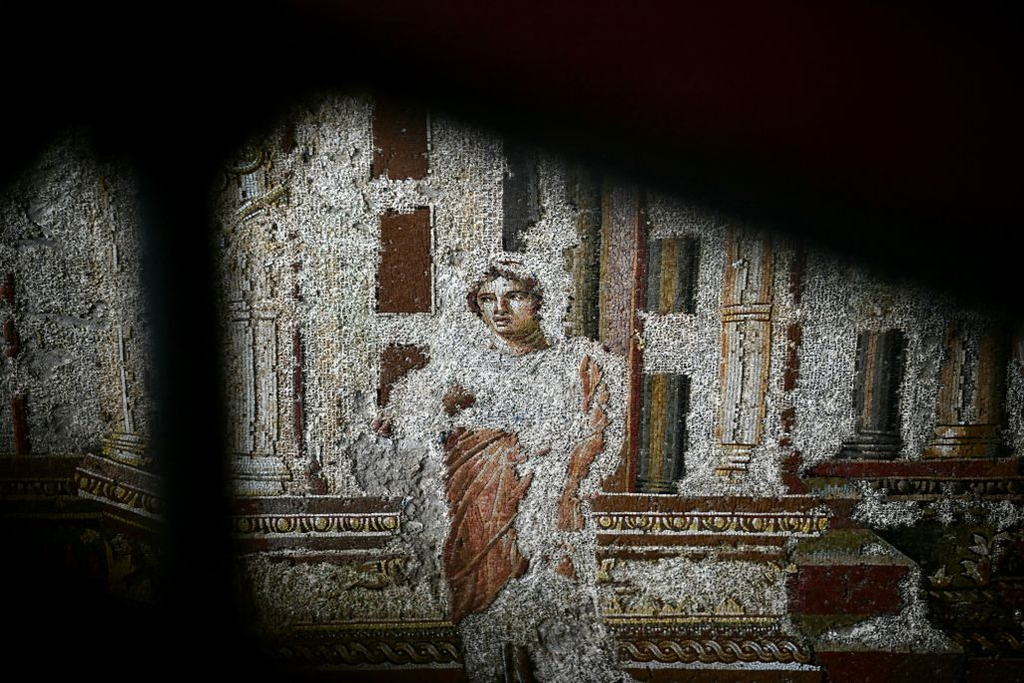
The massive first-century artworks, discovered beneath the Baths of Trajan in Rome during excavations in the 1990s, have been restored and are welcoming visitors for the first time under carefully controlled conditions.
After remaining hidden underground for centuries, two extraordinary works of ancient Roman art are finally being revealed to the public. A monumental wall mosaic and a remarkable fresco depicting a mysterious maritime city have opened to visitors in Rome, offering a rare glimpse into the artistic ambitions, architectural knowledge and cultural life of the Roman world nearly 2,000 years ago.
Known as the “Great Mosaic” and the “Painted City,” the artworks were discovered during archaeological excavations in the 1990s beneath the Baths of Trajan, near the Colosseum. Their recent restoration has made it possible for visitors to appreciate details that have survived beneath the modern city for generations.
The fresco presents a carefully arranged view of a walled city, complete with buildings, towers, a theater, a temple and public spaces. Yet its identity remains unknown. Archaeologists believe the depiction may represent a real and important port city, although no definitive identification has been established.
The mosaic is even more imposing in scale. Measuring approximately 15 meters, or about 49 feet, high in the section currently visible, it contains elaborate architectural designs, human figures and additional views associated with a maritime setting. Excavations are continuing to reveal more of the artwork.
The opening marks an important moment for Roman archaeology. Beyond their visual beauty, the paintings and mosaic provide evidence of the sophisticated artistic techniques used in antiquity and raise new questions about the buildings that once stood on Rome’s Oppian Hill.
A Remarkable Discovery Beneath the Baths of Trajan
The story of the artworks begins beneath one of ancient Rome’s most impressive public complexes.
The Baths of Trajan were inaugurated in 109 CE during the reign of Emperor Trajan. Designed by the architect Apollodorus of Damascus, the enormous complex occupied approximately six hectares, or around 15 acres, on the Oppian Hill near the Colosseum.
At the time, the baths were among the most ambitious public facilities in the Roman world. They provided spaces for bathing, exercise, relaxation and social interaction. Large Roman bath complexes were not simply places where people washed. They were important gathering places where citizens could meet friends, conduct informal business and participate in aspects of public life.
The Baths of Trajan also included architectural spaces that may have supported cultural activities, including areas believed to have functioned as libraries.
Beneath the ruins, however, lay evidence of an earlier architectural history. During excavations in the 1990s, archaeologists uncovered an underground gallery containing the Painted City fresco and the Great Mosaic.
The discoveries revealed that the area had undergone several stages of construction and transformation. Buildings were altered, buried and incorporated into later developments as Rome continued to expand.
The artworks are believed to date to the first century CE, before the Baths of Trajan were built. Their original setting and precise relationship to earlier structures remain subjects of archaeological investigation.
One possibility is that they belonged to a building associated with Emperor Nero’s Domus Aurea, or Golden House, the enormous palace complex constructed after the Great Fire of Rome in 64 CE. However, the exact origins of the artworks have not been conclusively established.
Their survival beneath later construction has helped preserve an extraordinary visual record of ancient Roman artistic culture.
The Painted City: A Mysterious Maritime World
The fresco known as the Painted City is one of the most intriguing elements of the discovery.
Covering approximately 10 square meters, the artwork depicts a walled urban landscape from an elevated, almost bird’s-eye perspective. Buildings, towers, public spaces and major structures are arranged to create an impression of a city viewed from above.
Its surviving blue and terracotta tones give the composition a distinctive appearance. Although the colors have faded over the centuries, they still provide a sense of the visual richness that once characterized Roman interior decoration.
The city appears to be associated with a maritime environment, making the fresco particularly valuable to historians interested in Roman ports, urban planning and architectural representation.
Its walls suggest a settlement of considerable importance. The buildings and public structures indicate an organized urban environment rather than a simple collection of houses.
Yet the question of identity remains unresolved.
Claudio Parisi Presicce, Rome’s cultural superintendent, has noted that archaeologists do not know which city the fresco represents. Its prominence and elaborate depiction suggest that the place may have been well known to the people who originally viewed the artwork.
Several possibilities might be considered when interpreting such a scene, including a real Mediterranean port or an idealized city assembled from familiar architectural features. However, there is not enough evidence to identify the location with certainty.
That uncertainty is part of what makes the fresco so fascinating. It offers a detailed image of an ancient urban world while withholding the name of the place it portrays.
For archaeologists, the artwork is not merely decorative. It may preserve clues about how Romans imagined cities, represented distant places and understood the relationship between architecture and power.
A Sophisticated Perspective Before the Renaissance
One particularly interesting feature of the Painted City is the way its buildings are arranged to create a sense of depth.
The elevated viewpoint allows several parts of the city to be seen at once. Instead of presenting every structure from a single ground-level angle, the artist offers an overview that makes the urban layout easier to understand.
This approach differs from the visual conventions familiar from much later European art, but it demonstrates that ancient artists could develop complex ways of representing space.
The fresco has therefore attracted attention for its possible significance in the history of perspective.
Renaissance artists and architects, including Filippo Brunelleschi, helped establish influential systems of linear perspective in the early 15th century. The Roman fresco predates those developments by more than a millennium.
It would be misleading, however, to suggest that the artwork uses precisely the same mathematical system later associated with Renaissance perspective. Ancient and Renaissance artists worked within different artistic traditions and used varied methods to communicate depth.
What the fresco demonstrates is that Roman painters could create sophisticated spatial compositions long before Renaissance theories of perspective became influential.
The representation may also have served a practical visual purpose. By showing multiple buildings and public spaces together, the artist could communicate the scale and complexity of a city in a single image.
For modern researchers, the work invites further study of ancient drawing methods, architectural knowledge and the relationship between observation and artistic invention.
The Great Mosaic: A Monumental Work of Roman Art
If the Painted City draws attention through its mysterious subject, the Great Mosaic impresses through its enormous scale and intricate decoration.
The currently revealed section measures approximately 15 meters high and around 16 meters wide, or about 52 feet across. Researchers believe it may be the largest wall mosaic discovered in the Roman world, although excavation work is ongoing and the full extent of the artwork remains unknown.
Unlike a conventional floor mosaic, which viewers generally observe from above, this monumental composition was designed for a vertical architectural setting.
It includes elaborate columns, decorated bases, architectural frames and figures arranged across multiple levels. Some scenes are presented close up, while other sections incorporate views of a port city from above.
Among the figures identified in the composition are a bearded philosopher, a centaur and a poet receiving a laurel crown. These elements bring together architectural decoration, mythology and human activity within a single monumental design.
The mixture of figures and architectural scenes gives the mosaic an almost theatrical quality. Its arrangement suggests an elaborate decorative program rather than a simple repeated pattern.
The scale of the work also indicates the resources required to produce it. Creating a wall mosaic of this size would have demanded substantial quantities of materials, careful planning and highly skilled labor.
Archaeologists continue to investigate its boundaries. A newly revealed section includes imagery associated with grape harvesting and winemaking, suggesting that further discoveries may add new themes and details to the composition.
Until more of the artwork is exposed, its complete design and original visual impact remain uncertain.
What the Mosaic Reveals About Roman Society
The Great Mosaic offers more than evidence of artistic skill. Its combination of architecture, people and symbolic imagery may help researchers understand the cultural environment in which it was created.
Roman mosaics often served several purposes at once. They decorated important spaces, demonstrated the wealth and taste of patrons, and communicated stories or ideas through recognizable images.
A monumental wall composition would have been especially effective in a large interior where visitors could encounter it as part of an architectural experience.
The presence of a philosopher and a poet suggests an interest in intellectual and cultural themes. The centaur introduces a mythological element, while the architectural scenes evoke the built environment and the urban world.
The imagery associated with a port city is also significant. Maritime trade connected Rome with communities throughout the Mediterranean, bringing goods, people and ideas into the capital.
Ports were essential to the movement of grain, wine, olive oil, pottery, luxury goods and other commodities. They were also places where languages, customs and artistic traditions met.
The mosaic does not, by itself, establish the identity of the city it depicts or explain the precise meaning of every figure. Nevertheless, its visual program reflects a world in which architecture, literature, mythology and urban life could be brought together in elaborate decorative art.
Further excavation and technical analysis may help clarify the relationship between the mosaic’s different sections and the building for which it was originally created.
Restoring Art That Survived for Nearly Two Millennia
Bringing the Painted City and Great Mosaic before the public required extensive conservation work.
Although being buried helped protect the artworks from many forms of weathering, underground conditions can create their own challenges. Moisture, salts, changes in temperature and the movement of building materials may affect historic wall paintings and mosaics.
Over time, deposits can also obscure the surface, reducing the visibility of colors, outlines and fine details.
The restoration project included cleaning, stabilizing fragile sections and consolidating the material holding the decoration in place. The goal was to improve visibility while preserving the original surfaces.
Such work requires careful judgment. Removing too much material or using unsuitable techniques can damage evidence that has survived for centuries. Conservation specialists must therefore balance the desire to reveal an artwork with the need to protect its historical integrity.
The recent restoration has brought greater clarity to the surviving colors and decorative details, allowing visitors to appreciate the scale and complexity of the works.
The project is also part of a broader effort to improve access to archaeological heritage in Rome. The newly accessible spaces include a monumental semicircular structure, known as an exedra, which archaeologists believe may have served as a library or a similar cultural space.
The niches in the structure appear to have accommodated books or documents, although its precise use remains a matter of interpretation.
Together, the restored gallery and surrounding architectural remains provide a fuller picture of the layered history of the Oppian Hill.
Why Public Access Is Being Carefully Controlled
The opening of the artworks does not mean that the underground site can immediately accommodate unlimited visitors.
Initially, access is being offered to small groups, with approximately 15 people per group during a trial period. Guided visits are intended to allow the public to see the restored works while conservation teams monitor the conditions inside the gallery.
Human presence can change the environment of an enclosed archaeological space. Visitors introduce moisture and carbon dioxide through breathing, and larger crowds may cause fluctuations in temperature and humidity.
These changes can affect fragile wall paintings, mosaics and other ancient materials, especially when the environment must remain relatively stable to support long-term preservation.
By limiting group sizes and monitoring the site, officials can gather information about how the artworks respond to public access before considering whether visits can be expanded.
This cautious approach reflects a central challenge in heritage management: historic sites must be made accessible without putting the objects that make them valuable at risk.
The opening also gives researchers an opportunity to evaluate how visitors move through the space and whether existing walkways, lighting and viewing areas are sufficient.
For people visiting Rome, the controlled access offers an opportunity to see an extraordinary archaeological discovery that remained unavailable to the public for decades after it was first uncovered.
A New Chapter in Rome’s Archaeological Story
Rome is famous for its ancient monuments, from the Colosseum and the Roman Forum to the remains of imperial palaces and public baths. Yet the city’s archaeological record continues to develop as researchers study areas that have been hidden beneath later construction.
The Painted City and Great Mosaic illustrate how much remains to be learned from spaces that may appear familiar on the surface.
The Baths of Trajan were already important as a major example of Roman engineering and public architecture. The discovery and restoration of the underground artworks add another dimension to the site’s history, revealing evidence of an earlier artistic environment beneath the imperial complex.
The artworks also encourage researchers to reconsider how richly decorated buildings were designed and experienced. Their scale suggests that the original space was intended to make a strong visual impression on its occupants.
Whether the fresco depicts a real port or an idealized urban landscape, it provides a rare opportunity to study how ancient Romans represented cities. The mosaic, meanwhile, demonstrates the technical ambition of large-scale wall decoration.
Together, the works connect architecture, painting, mosaic-making and cultural history in a way that few surviving sites can offer.
Conclusion: Ancient Rome’s Hidden Masterpieces Finally Come Into View
The opening of the Painted City fresco and Great Mosaic marks a significant moment for the study of ancient Rome. Discovered beneath the Baths of Trajan during excavations in the 1990s, the first-century artworks have undergone restoration and are now welcoming visitors under controlled conditions.
The fresco depicts a mysterious walled maritime city whose identity remains unknown, while the monumental mosaic combines elaborate architectural decoration with human figures, mythological imagery and further views of an urban landscape.
Their survival offers a remarkable window into Roman artistic achievement, from the representation of space to the planning and execution of enormous decorative compositions.
The site also demonstrates why archaeological conservation is an ongoing responsibility. Making the artworks accessible requires careful management to ensure that visitors can appreciate them without compromising their preservation.
Nearly 2,000 years after these images were created, their details continue to raise questions about the people who commissioned them, the buildings they once decorated and the city that may have inspired the painters and mosaicists.
For Rome, the discovery is another reminder that the ancient world is not simply a collection of familiar monuments. Beneath its streets and hills, new evidence can still transform our understanding of the past—and bring forgotten masterpieces back into view.