A devastating mass shooting in Erie, Pennsylvania, has left a community grieving after a 45-year-old man allegedly killed eight people, including two young children and his pregnant daughter, before dying by suicide. The shooting occurred on Friday, October 9, 2026, at a residence on Perry Street, leaving multiple generations of one family dead and raising painful questions about how such a tragedy could unfold.
Authorities identified the shooter as Matthew Stone Sr. The victims included members of his own family and a family friend. Among those killed were his 24-year-old daughter, Angelina Stone, who was approximately eight months pregnant, her two young children, and other relatives. The unborn baby also died.
The tragedy has shaken Erie, a city in northwestern Pennsylvania, as investigators work to establish what led to the violence. Relatives and community members have struggled to reconcile the devastating events with their memories of the man at the center of the case.
As the investigation continues, the loss extends far beyond the immediate crime scene. Families have been left to mourn loved ones, including young children whose lives had only just begun, while neighbors and friends seek answers that may take time to emerge.
A Horrific Shooting Shakes Erie, Pennsylvania
Police were alerted to gunfire in the 700 block of Perry Street at approximately 4:53 p.m. on October 9. Authorities responded after a gunshot-detection system registered possible gunfire in the area.
When officers arrived, they encountered a scene that Erie Police Chief Rick Lorah later described as horrific. Two women, aged 51 and 37, were found dead outside the residence. Additional victims were discovered inside the home.
Investigators ultimately determined that eight people had been killed by the gunman before he died from an apparent self-inflicted gunshot wound. The overall death toll was nine, including the shooter.
The victims included two young children, several adult family members, a pregnant woman, and a family friend. Police said seven of the eight victims were related to the suspected gunman.
The circumstances made the incident particularly devastating. Rather than involving strangers in a public location, the violence unfolded in and around a family home, where multiple generations had connections to one another.
Chief Lorah described the scene as one of the worst he had encountered during his career. His comments reflected the emotional weight of an investigation involving so many deaths in a single residence.
Authorities have emphasized that the circumstances remain under investigation. Although the identity of the shooter and several victims has been established, the motive behind the attack has not been definitively determined.
Who Was Matthew Stone Sr.?
Matthew Stone Sr., 45, was identified as the man responsible for the fatal shooting. Relatives and people familiar with the family have described the shock of learning that someone they knew was connected to such an extraordinary act of violence.
Julius Windham, the father of one of the young victims, spoke publicly about his disbelief. Windham said Stone had appeared cheerful and ordinary in everyday interactions, making the events difficult to comprehend.
According to Windham, the man had often seemed to be smiling. The contrast between those memories and the deadly shooting has left family members searching for explanations.
Windham suggested that the outward appearance people saw may not have revealed everything Stone was experiencing. However, investigators have not established a definitive motive, and the available information does not establish precisely what led to the attack.
It is important not to draw conclusions about a person’s mental state based solely on a tragedy or on the observations of people who knew them. Investigators must rely on evidence, interviews, and other relevant information to understand the circumstances.
For the families affected, however, the question of who Stone was has become inseparable from the painful reality of what happened.
They are now confronting the loss of people they loved while trying to understand how a family gathering or ordinary day could end in such widespread devastation.
The Victims Included a Pregnant Woman and Two Young Children
Among the most heartbreaking aspects of the shooting was the death of Angelina Stone, 24, who was reportedly due to give birth within days of the attack.
Angelina’s two young children, a five-year-old boy and a one-year-old girl, were also killed. The unborn baby did not survive.
The deaths meant that one young family lost several members in a single incident. For the children’s surviving relatives, the tragedy represents the loss of both a future they had anticipated and the everyday memories that can never be replaced.
Angelina’s pregnancy made the timing especially painful. Her family had been approaching the arrival of a new baby, a moment that would ordinarily bring preparation, excitement, and anticipation.
Instead, relatives were forced to confront the deaths of Angelina and her children, along with the loss of the unborn child.
Authorities have withheld the names of the two young children in some official releases, in accordance with state law. Their father, Julius Windham, publicly identified his one-year-old daughter as Amarianna.
The other victims included Michelle Stone, 44, and two young adult men, Matthew Stone Jr., 21, and Jonathan Stone, 19. Two women, Lora Roberts, 37, and Twila Tanner, 51, were killed outside the home.
The victims had their own relationships, responsibilities, and lives beyond the circumstances of the shooting. As their names and connections become known, the tragedy is increasingly understood not simply as a crime scene but as the loss of an entire network of family and community relationships.
Two Women Were Killed Outside the Home
Investigators said Roberts and Tanner were found dead outside the residence when officers arrived.
Information gathered during the investigation included audio and video evidence suggesting that gunfire had occurred inside the home before the two women approached the property. Reports indicated that they appeared distressed and were attempting to reach or enter the residence.
The precise reasons for their actions remain part of the broader investigation. Authorities have indicated that the women’s cellphones may provide important information about what they knew and why they went to the home.
Their deaths add another layer of tragedy to an already devastating case. They were not simply bystanders to the aftermath; they became victims of the violence themselves.
The circumstances have prompted questions about whether anyone outside the residence understood the danger before police arrived. However, investigators have not established a complete account of the events leading up to the shooting.
Police have explained that officers did not hear further gunshots or cries for help when they first arrived. They subsequently entered the residence and discovered the additional victims.
Authorities have said the available evidence indicates that the deaths occurred before officers entered the home. Officials have not suggested that an active exchange of gunfire took place between the suspect and responding officers.
The investigation continues to examine the sequence of events and the information available to emergency responders.
Police Continue to Investigate the Motive
One of the most difficult questions surrounding the Erie shooting is why it happened.
As of the latest reported updates, authorities had not established a definitive motive. Police Chief Lorah suggested that mental health could be a factor, but he did not present a confirmed explanation for the violence.
That distinction matters. A mass shooting involving a family can lead to immediate speculation about arguments, financial problems, personal grievances, or psychological distress. Without verified evidence, however, those possibilities should not be treated as established facts.
Investigators have been interviewing relatives and examining evidence that could clarify the events preceding the attack. The cellphones of the two women killed outside the home have also drawn attention because they may help establish their movements and communications before the shooting.
Such evidence can help investigators reconstruct a timeline, determine whether anyone had expressed concern, and identify interactions that may be relevant to the case.
Even when an investigation establishes a clear sequence of events, understanding a motive can be more complicated. People who knew the suspect may have different memories of his behavior, and those observations do not always provide a complete explanation.
For the victims’ families, the absence of answers may make grieving even more difficult. They must cope with the deaths of loved ones while waiting for investigators to clarify the circumstances.
Authorities have urged caution as the inquiry proceeds, with the focus remaining on evidence rather than speculation.
A Family’s Shock and a Community’s Grief
The shooting has prompted an outpouring of grief in Erie, where residents have gathered to remember the victims and express support for their surviving relatives.
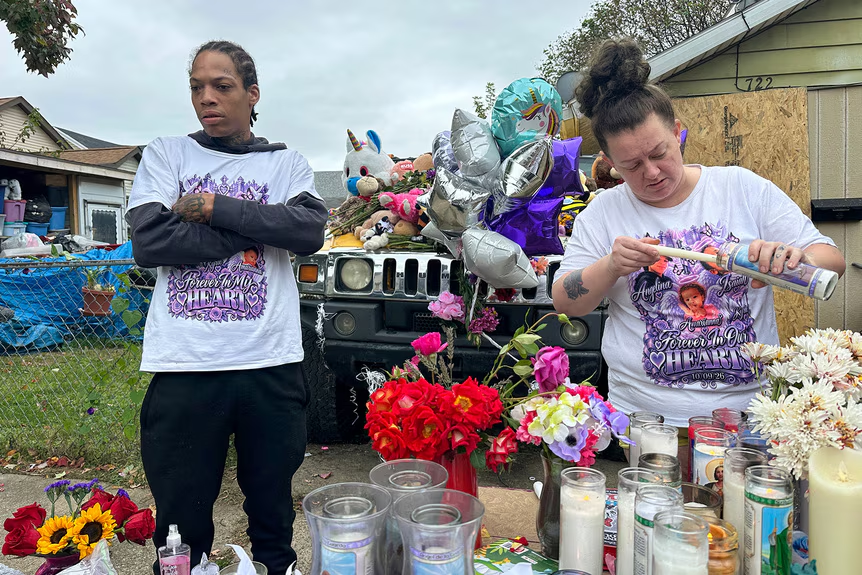
Flowers, candles, and other tributes have been placed near the residence. Such memorials offer people a way to acknowledge the lives lost and show families that they are not facing the aftermath entirely alone.
Windham has spoken about the challenge of remaining strong following the death of his young daughter. His comments reflect the extraordinary burden faced by parents and relatives who have lost children in circumstances that are difficult to comprehend.
For those who knew the victims, grief is likely to take many forms. Some will remember family celebrations and everyday conversations; others will struggle with the sudden absence of people who had been part of their daily lives.
The loss of multiple generations also means that different branches of the family may be grieving simultaneously. Surviving relatives may find themselves supporting one another while processing their own shock and sadness.
Community support can provide practical assistance as well as emotional comfort. Neighbors, friends, local organizations, and other residents may help families navigate funeral arrangements, financial pressures, and the demands of daily life after a sudden loss.
However, public attention can also make an already painful period more difficult. Families deserve time and privacy to mourn without feeling obligated to explain their experiences to strangers.
As the investigation continues, the focus for many residents remains on remembering the victims and supporting those left behind.
The Wider Questions Raised by Family Violence
The Erie shooting has also renewed attention to the devastating consequences of violence within families.
When a person kills relatives, the people affected are often connected through generations of shared history. Parents, children, siblings, grandparents, and extended family members may all be caught in the same tragedy.
Such incidents can leave survivors facing complicated emotions, particularly when the person responsible was someone they once trusted or regarded as a familiar presence in their lives.
Yet it is important to avoid assuming that every family tragedy follows the same pattern or that one explanation can account for all such acts of violence.
The circumstances of the Erie shooting remain under investigation. The facts established so far describe the scale of the loss, the relationships among many of the victims, and the apparent suicide of the gunman. They do not, by themselves, explain the motive.
The case also highlights the importance of taking credible threats of violence seriously and ensuring that people experiencing severe distress can access appropriate support. At the same time, mental health challenges should not be treated as synonymous with violence, and no diagnosis should be inferred from a person’s actions alone.
For communities dealing with a mass-casualty event, the immediate needs are often practical and deeply personal: helping surviving relatives, supporting grieving children and adults, and ensuring that people affected by the incident can access professional assistance if needed.
Longer-term understanding requires careful investigation rather than speculation.
Remembering the People Behind the Headlines
As details continue to emerge, the story of the Erie shooting risks being reduced to a single shocking headline. But the victims were more than names in an investigation, and their lives cannot be defined solely by the circumstances of their deaths.
Angelina Stone was a young mother preparing for the birth of another child. Her two young children had lives ahead of them. The adult relatives and family friend who died also had relationships and histories that mattered to the people who knew them.
Their deaths have left surviving family members facing an unimaginable loss. For them, the consequences will continue long after news coverage moves on to other events.
Authorities must now work to establish a fuller timeline, clarify the events leading to the shooting, and determine whether additional evidence can explain what happened. Until that work is complete, many questions will remain unanswered.
The tragedy has also shown how quickly a familiar environment can become the center of a devastating emergency, leaving families and communities struggling to understand an event that seemed impossible to anticipate.
An Investigation Continues as Erie Mourns
The fatal shooting in Erie, Pennsylvania, on October 9, 2026, claimed the lives of eight people, including two young children, a pregnant woman, several relatives, and a family friend. The 45-year-old gunman, Matthew Stone Sr., also died, bringing the total number of deaths to nine.
Police have continued to investigate the circumstances surrounding the attack, including the events before officers arrived and the possible motive. Although some of the victims have been identified, the full story of what led to the shooting remains incomplete.
For the community, the immediate priority is mourning the dead and supporting those whose lives have been permanently changed.
The tragedy serves as a painful reminder that behind every major crime are individual lives, grieving families, and communities left to rebuild after sudden loss.
As investigators continue their work, the hope is that verified information will provide a clearer understanding of the events without adding to the suffering of those already affected.
For now, Erie is left to remember the eight people who were killed, support the families they leave behind, and confront the difficult questions raised by one of the most devastating acts of violence the city has experienced.