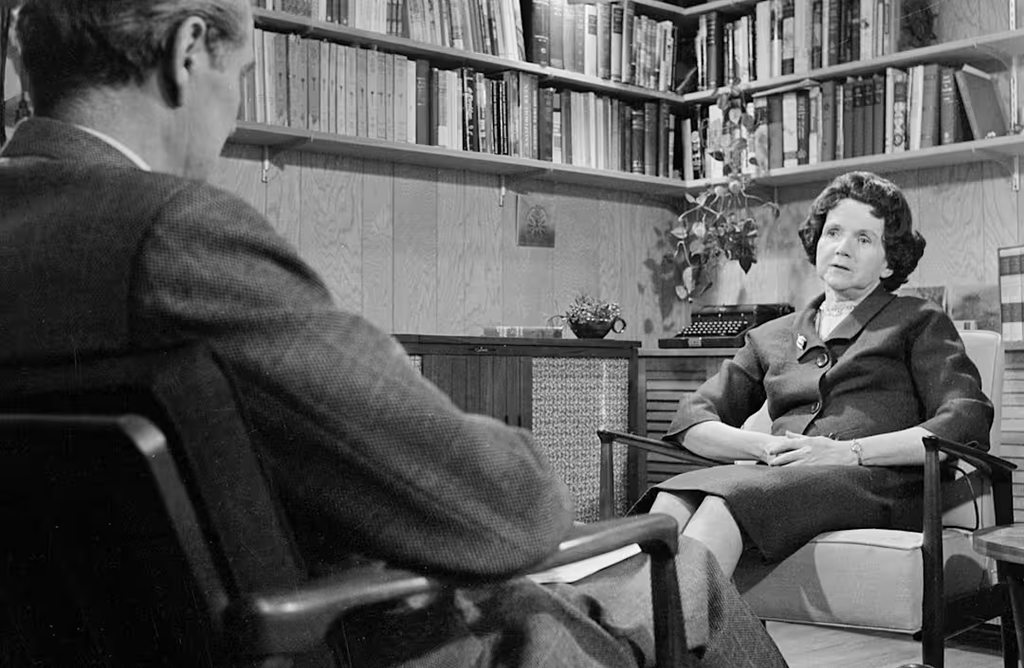
In 1962, American marine biologist and writer Rachel Carson published a book that would transform the way millions of people understood the natural world. Silent Spring challenged the widespread belief that chemical pesticides were an uncomplicated solution to agricultural pests and public health problems. Instead, Carson warned that the careless use of these chemicals could contaminate ecosystems, harm wildlife, and potentially threaten human health. Her message was clear: technological progress should not come at the expense of the environment.
At the time, synthetic pesticides were widely celebrated as symbols of scientific achievement. They helped farmers control insects, supported agricultural production, and were used in efforts to eliminate disease-carrying pests. Chemical companies and some government agencies promoted these products as essential tools of modern life. Against this background, Carson’s warnings challenged powerful interests and sparked an intense public debate.
More than six decades later, Silent Spring remains one of the most influential environmental books ever published. It helped bring environmental concerns into mainstream public discussion, encouraged greater scrutiny of pesticide use, and contributed to a broader movement for environmental protection. Carson did not single-handedly create modern environmentalism, but her work gave a growing public movement a compelling scientific foundation and a memorable call to action.
Who Was Rachel Carson?
Rachel Carson was born on May 27, 1907, in Springdale, Pennsylvania. From an early age, she developed a deep interest in nature and writing. Her fascination with the natural world eventually led her to study biology, first at the Pennsylvania College for Women, now Chatham University, and later at Johns Hopkins University, where she pursued graduate studies in zoology.
Carson built a career as a marine biologist, science writer, and government employee. She worked for the U.S. Bureau of Fisheries, which later became part of the U.S. Fish and Wildlife Service. Her scientific background gave her the skills to examine environmental questions, while her talent for writing helped her explain complex biological processes to general readers.
Before Silent Spring, Carson had already achieved considerable success with books about the ocean. Under the Sea-Wind, published in 1941, explored marine life through vivid descriptions of coastal and ocean ecosystems. The Sea Around Us, released in 1951, became a bestseller and earned major literary recognition. The Edge of the Sea, published in 1955, further established her reputation as a writer who could connect scientific knowledge with an appreciation of nature.
These earlier works revealed Carson’s ability to make scientific subjects accessible without losing their complexity. She described the natural world as an interconnected system, where individual organisms depended on countless relationships with other forms of life.
That perspective became central to Silent Spring. Carson believed that understanding nature required looking beyond the immediate effects of human actions and considering the wider consequences that might emerge over time.
What Inspired the Writing of Silent Spring?
By the middle of the twentieth century, synthetic chemical pesticides had become increasingly common in agriculture and public health programs. One of the best-known was DDT, a powerful insecticide that had been used extensively during and after the Second World War.
DDT proved effective against many insects, including mosquitoes and agricultural pests. Its use expanded rapidly because it could help protect crops and reduce certain insect-borne diseases. However, scientists were also beginning to investigate its persistence in the environment and its effects on wildlife.
Carson became increasingly concerned about reports of pesticide spraying and its potential consequences for birds, fish, and other animals. Correspondence from people who had witnessed environmental damage helped reinforce her determination to investigate the issue.
She began examining scientific studies and bringing together evidence about how pesticides moved through ecosystems. Her research considered the effects of chemicals on organisms that were not the intended targets, as well as the possibility that repeated exposure could produce consequences far beyond the original application site.
Carson’s work challenged the assumption that a chemical designed to kill a pest would affect only that pest. In the natural world, she argued, substances could move through soil, water, plants, insects, birds, and other animals. A pesticide released into one part of an ecosystem might therefore affect organisms that had never been considered when the chemical was first applied.
This approach made her argument especially powerful. Rather than focusing on isolated incidents, Carson presented pesticide use as a question about the relationships connecting entire ecosystems.
Why Silent Spring Became a Landmark Environmental Book
Published on September 27, 1962, Silent Spring examined the environmental consequences of widespread pesticide use. Its title suggested a disturbing possibility: a future springtime in which birds no longer sang because their populations had been devastated by chemical contamination.
Carson did not claim that every pesticide had identical effects or that all chemical pest control should be abandoned. Her central argument was that pesticide use needed to be evaluated carefully, with attention to long-term consequences, ecological relationships, and potential harm to humans and wildlife.
The book combined scientific research with accessible storytelling. Carson explained how chemicals could persist in the environment, accumulate in organisms, and move through food chains. She also discussed the possibility that pesticides could kill beneficial insects and other wildlife while disrupting natural systems that helped control pests.
One of her most important points was that the effects of pesticides could extend beyond the immediate location where they were applied. A chemical sprayed over farmland might reach nearby waterways, affect aquatic organisms, or enter the bodies of animals that consumed contaminated food.
Carson’s writing made these processes understandable to readers without specialized scientific training. She used vivid examples to demonstrate how decisions made for agricultural convenience could create unintended environmental consequences.
The book’s influence came partly from this combination of scientific evidence and moral urgency. Carson asked readers to reconsider the meaning of progress. If a technology increased production but damaged ecosystems and threatened public health, could it truly be considered an unquestionable benefit?
That question resonated with readers and helped bring environmental protection into a broader conversation about science, government, industry, and public responsibility.
The Science Behind Carson’s Warning About DDT
DDT became one of the central examples in Silent Spring because of its effectiveness as an insecticide and its persistence in the environment.
Unlike substances that break down quickly, DDT can remain in soil and sediment for extended periods. It is also fat-soluble, meaning it can accumulate in the fatty tissues of organisms. As contaminated organisms are eaten by predators, the chemical can move through food webs.
This process can contribute to bioaccumulation, in which a substance builds up within an organism over time, and biomagnification, in which concentrations increase at higher levels of certain food chains.
Birds of prey became an important example of the ecological consequences associated with persistent organochlorine pesticides. Exposure to DDT’s breakdown product, DDE, was linked to eggshell thinning in several bird species. Fragile eggs were more likely to break during incubation, contributing to reproductive declines in affected populations.
The issue was especially serious because the chemicals could influence wildlife far from the places where pesticides were originally applied. The movement of contaminants through ecosystems meant that environmental damage could be difficult to predict and even harder to reverse.
Carson also raised concerns about the possible effects of pesticide exposure on human health. The scientific understanding of many long-term health effects was still developing in 1962, and some of the risks discussed in the book remained subjects of continuing research.
Her argument encouraged scientists and public officials to examine these questions more carefully. It also helped popularize the idea that the safety of a chemical should not be judged solely by whether it performed its intended task.
The Backlash Against Rachel Carson
The publication of Silent Spring sparked an intense controversy. While many readers praised Carson’s research and writing, sections of the chemical industry strongly opposed her conclusions.
Critics argued that pesticides were essential for maintaining agricultural productivity and controlling insects that spread disease. Some accused Carson of exaggerating risks or relying too heavily on evidence that did not support a complete picture of pesticide benefits.
Others questioned her scientific authority, sometimes emphasizing that she was a writer and government biologist rather than a specialist in every field discussed in the book.
Carson’s critics also warned that restrictions on pesticide use could increase crop losses, raise food prices, and undermine public health programs. These concerns reflected real questions about how societies should balance the benefits of pest control against environmental and health risks.
However, some attacks went beyond scientific disagreement. Carson faced personal criticism and efforts to undermine her credibility, including attempts to portray her as unqualified to discuss the subject.
She responded by emphasizing the evidence and the need for careful evaluation rather than accepting pesticides as inherently safe. Her position was not that all chemicals were equally dangerous, but that their use required rigorous assessment and responsible oversight.
The controversy ultimately increased public interest in the book. Newspapers, broadcasters, scientists, politicians, and ordinary readers debated the issues it raised.
By forcing pesticide safety into the national conversation, the controversy helped establish environmental risk as a question that deserved public scrutiny rather than a matter left exclusively to manufacturers and government experts.
How Silent Spring Changed Public Awareness
Before Silent Spring, environmental concerns were already present in scientific research and conservation efforts. However, Carson helped connect these issues to everyday life in a way that reached a much broader audience.
Readers began to consider how chemical use might affect birds in their gardens, fish in nearby rivers, drinking water, farmland, and the health of their families. The environment was no longer simply a distant wilderness to be protected. It was also the air people breathed, the water they used, and the living systems surrounding their communities.
Carson’s book encouraged people to question whether the benefits of pesticides justified every application. It also challenged the assumption that nature could be controlled without consequences.
The book became a bestseller and attracted widespread media attention. Public discussion expanded beyond the scientific community, creating pressure for further research and stronger oversight of pesticide use.
Environmental organizations gained a powerful new argument for examining pollution and ecological damage. Teachers, students, scientists, and civic groups also found in Carson’s work a framework for discussing the relationship between human activity and the natural world.
Importantly, Silent Spring helped change the language of environmental debate. Rather than treating isolated incidents of wildlife death as unfortunate accidents, readers were encouraged to consider whether they reflected broader patterns of chemical exposure and ecological disruption.
The book’s influence was not limited to pesticide policy. It helped strengthen a growing environmental movement that would later address air pollution, water contamination, habitat destruction, and other issues.
The Political and Legal Legacy of Silent Spring
The debate surrounding Silent Spring reached the highest levels of American government.
In 1963, President John F. Kennedy’s administration responded to growing concerns about pesticide safety by examining the issue through a scientific advisory process. The resulting attention helped reinforce the need for more systematic assessment of chemical risks.
Over the following decade, public concern about pollution continued to grow. The first Earth Day, held on April 22, 1970, brought millions of Americans into environmental demonstrations and educational events. Although Earth Day had many influences and causes, Carson’s work had helped establish the scientific and public context in which environmental protection gained political momentum.
The Environmental Protection Agency was created in 1970 to consolidate and strengthen federal environmental responsibilities. In the years that followed, pesticide regulation became more closely associated with environmental protection and public health oversight.
In 1972, most uses of DDT in the United States were banned, subject to limited exceptions. The decision followed years of scientific investigation, regulatory debate, and growing concern about the pesticide’s environmental effects. It would be inaccurate to attribute the ban to Carson alone, but Silent Spring had played an important role in making the issue visible and politically significant.
International attention to persistent organic pollutants continued in later decades. DDT was eventually included among the chemicals addressed by the Stockholm Convention on Persistent Organic Pollutants, adopted in 2001. The agreement established international controls on several persistent chemicals, while allowing specific exemptions for certain uses, including disease-vector control under defined conditions.
These developments reflected a broader shift toward evaluating chemicals according to their environmental persistence, toxicity, and ability to travel through ecosystems.
Rachel Carson’s Legacy in Modern Environmentalism
Rachel Carson died on April 14, 1964, at the age of 56, less than two years after Silent Spring was published. She did not live to see the full development of the environmental movement that her work helped inspire.
Nevertheless, her influence continues through environmental science, public policy, education, and conservation. Carson demonstrated that scientific knowledge could be communicated in language that ordinary readers understood, without sacrificing the seriousness of the evidence.
Her work also helped establish an important principle: the absence of immediate visible harm does not necessarily mean a chemical or industrial practice is safe. Environmental consequences may emerge gradually, travel across large areas, or affect species that were never the original target.
Modern environmental assessment builds on this principle by examining exposure, toxicity, persistence, ecological effects, and potential risks to human health. Researchers also consider how pollutants interact with complex ecosystems and how uncertainty should influence decisions about their use.
Carson’s legacy is particularly relevant as societies confront contemporary challenges such as biodiversity loss, water pollution, plastic contamination, and the effects of industrial chemicals. Although these problems differ from the pesticide issues she examined, they raise a similar question: how can technological and economic development proceed without creating unacceptable environmental costs?
Her work remains influential because it encouraged people to look beyond immediate convenience and consider the long-term consequences of human decisions.
Why Silent Spring Still Matters Today
More than sixty years after its publication, Silent Spring remains a landmark in environmental history because its central questions have not disappeared.
Modern agriculture depends on multiple methods of pest management, including chemical pesticides, biological controls, crop rotation, and other techniques. Pesticides can provide significant benefits when used appropriately, including protecting crops and controlling disease-carrying insects. At the same time, their risks vary according to the chemical, dose, exposure, application method, and surrounding ecosystem.
Carson’s legacy is not a simple rejection of science or technology. Instead, it is an argument for science that examines consequences as carefully as benefits.
Her work also reminds readers that environmental protection depends on transparent information and meaningful public participation. Decisions about chemicals can affect farmers, workers, consumers, wildlife, and communities living near agricultural or industrial areas. These groups need reliable evidence to understand the risks and benefits involved.
The book continues to encourage scientists, policymakers, and citizens to ask difficult questions before environmental damage becomes widespread. It also highlights the importance of independent research and the willingness to challenge established practices when new evidence raises concerns.
Perhaps most importantly, Silent Spring changed how many people understood their relationship with nature. The natural world was not an unlimited resource that could absorb every consequence of human activity. It was a network of interconnected systems whose health depended, in part, on the decisions people made.
Conclusion: The Book That Helped Awaken an Environmental Movement
Rachel Carson’s Silent Spring was more than a bestselling book about pesticides. It was a turning point in the public discussion of environmental responsibility.
By examining the effects of chemical pesticides on wildlife, ecosystems, and potential human health, Carson challenged assumptions that had allowed widespread chemical use to proceed with insufficient attention to long-term consequences. Her research and accessible writing helped readers understand that environmental damage could emerge from ordinary practices carried out on an enormous scale.
The backlash against the book revealed how deeply the issue divided industry, government, and the public. Yet the debate also helped establish pesticide safety as a matter of scientific investigation and public concern.
Carson did not create environmentalism on her own, nor did her book resolve every question about pesticides. Its lasting achievement was to change the questions society was willing to ask. It helped make environmental protection a mainstream public issue and contributed to the wider movement that shaped modern environmental policy.
Today, Silent Spring remains a reminder that scientific progress carries responsibilities. Technology can improve lives, but its benefits must be weighed against potential harm to people and the natural world.
Rachel Carson’s warning continues to resonate because protecting the environment requires more than reacting after damage occurs. It demands curiosity, evidence, accountability, and the courage to reconsider familiar practices when the facts suggest that change is necessary.